Amazon is scheduled to release its latest quarterly earnings after the U.S. market close on April 29, 2026. Consensus estimates call for total revenue of $177.3 billion, up 14.36% year-over-year, and adjusted EPS of $1.64, up 20.22% year-over-year.
Key Takeaways: Options markets are pricing roughly ±7.5% expected stock price movement for the earnings week. Large trades indicate institutional investors are primarily selling out-of-the-money calls to generate income, while also establishing calendar spreads to play a range-bound scenario. Additionally, far-dated put purchases serve as downside protection. Overall, the strategy leans neutral-to-bearish, anticipating post-earnings volatility will decline.
AMZN Earnings Week Options Metrics
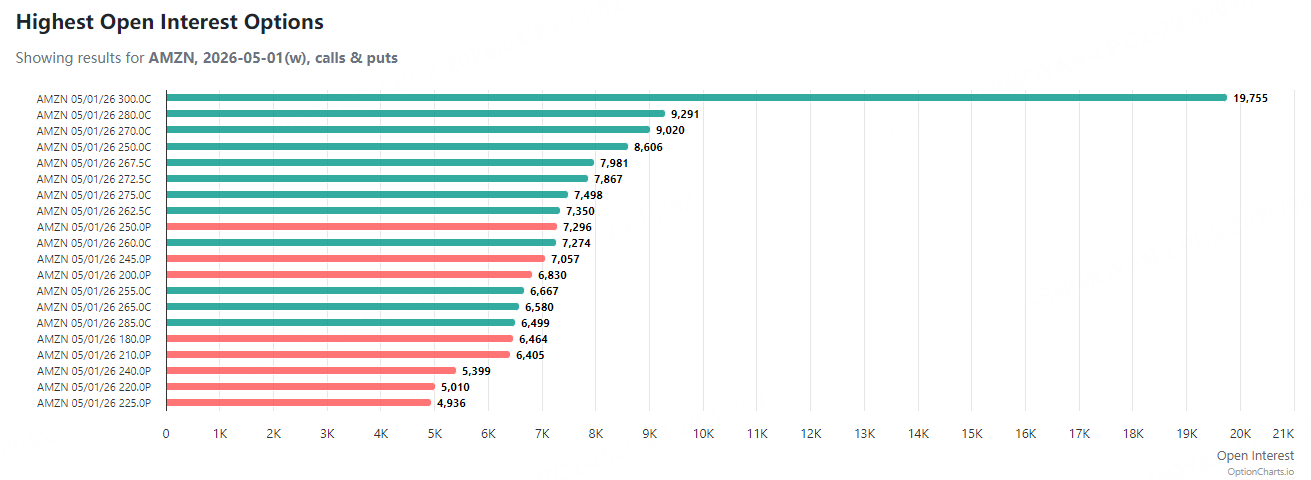
1. Notable Open Interest Contracts
Call $300: 19,755 contracts open, the highest single-contract open interest, suggesting concentrated bets on a substantial upside.
Put $250: 7,296 contracts open, a key level for downside protection.
Call $270: 9,020 contracts open, aligning with recent large trades involving $270 call calendar spreads, warranting close attention.
2. Implied Volatility & Expected Price Range
The overall IV for Amazon options expiring May 1, 2026, is 101.31%, translating to an expected weekly price movement of ±7.49%. This indicates a roughly 68% probability that AMZN shares will move up or down about 7.49% between earnings release and May 1 expiry.
Amazon’s last close was $259.70. According to options pricing, the expected primary trading range during earnings week is $240.30 to $279.10.
3. Large Trade Analysis: Sellers Dominating, Range-Bound & Hedged Positions
The following highlights large trades over the past three trading days (excluding expired contracts; notional = volume × price × 100). Trades are classified as in/out-of-the-money based on AMZN reference price ~$270 on April 29, 2026.
Overall Direction & Volatility Context
Market activity leans toward selling calls and buying far-dated puts, with notable calendar spreads (buying far, selling near).
This signals a neutral-to-slightly bearish stance, playing time decay and expected post-earnings volatility contraction.
IV percentile: 86.45%, IV/HV ratio: 1.56, Put/Call ratio: 0.58 — volatility remains elevated, favoring premium collection via OTM call selling.
Calendar Spread Trades (same-strike, different expirations)
C270 Calendar Spread (buy May 15, sell May 1)
Trade 1: 5,700 contracts; net debit $1.30 per contract; total $741,000
Trade 2: 5,500 contracts; net debit $1.30 per contract; total $715,000
Strategy Insight: These large calendar spreads bet on AMZN trading near $270. Near-term May 1 calls decay faster than far-term May 15 calls, allowing traders to capture time decay while expecting limited post-earnings directional movement.
Single-Leg Trades
Sell C275 Jan 15, 2027 (OTM Call): 3,100 contracts at $28.61; notional $8.87 million $AMZN 20270115 275.0 CALL$
Implication: Selling far-dated OTM calls to collect premium, reflecting a “volatility sell” and range-bound view, expecting difficulty breaking $275.
Buy P235 Jan 15, 2027 (OTM Put): 1,500 contracts at $17.44; notional $2.62 million $AMZN 20270115 235.0 PUT$
Implication: Long-dated downside protection.
Sell C310 Aug 21, 2026 (OTM Call): 2,500 contracts at $6.56; notional $1.64 million $AMZN 20260821 310.0 CALL$
Implication: Selling deep OTM calls, reinforcing expectations that the stock is unlikely to surge, capturing premium.
Key Conclusions
Largest Trades by Notional: Far-dated C275 sale ($8.87 million) and C270 calendar spreads (net debit $1.456 million combined).
Directional Bias: Primarily OTM call selling, supplemented by far-dated put purchases and calendar spreads — overall neutral-to-bearish, targeting range-bound movement and time decay.
Market Insight: Smart money appears to be monetizing elevated pre-earnings volatility, while managing downside risk via spreads and protective puts.
Strategy Reference: Investors seeking to implement a seller-leaning earnings strategy may consider selling OTM calls (e.g., $300+ strikes) with lower probability of being exercised. For limited-risk bearish positioning, a bear put spread (buy $280 put, sell $260 put) allows playing for the lower half of the expected $240–$279 trading range without unlimited risk exposure.
Comments