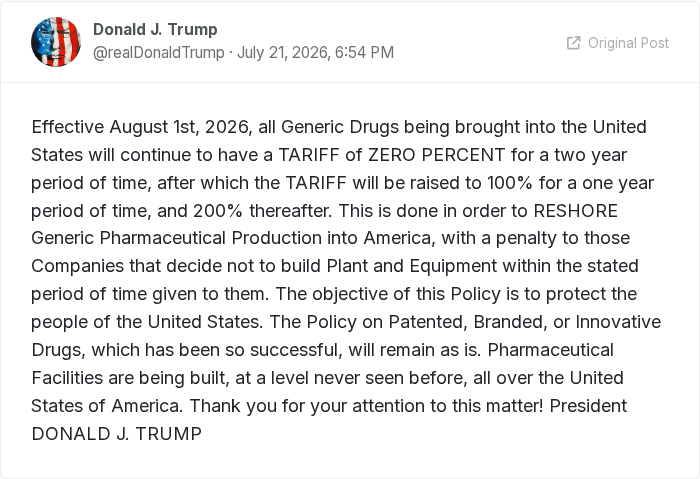
President Donald Trump announced on July 21 that effective August 1, 2026, all generic drugs imported into the United States will face a zero percent tariff for two years, followed by a 100% tariff for one year, and then 200% thereafter. The policy is designed to incentivize pharmaceutical companies to build manufacturing facilities in the United States.
"This is done in order to RESHORE Generic Pharmaceutical Production into America, with a penalty to those Companies that decide not to build Plant and Equipment within the stated period of time given to them," Trump wrote on X. The president emphasized that the objective is to protect the people of the United States.
Under the plan, the current tariff regime for patented, branded, or innovative drugs will remain unchanged. Trump claimed that pharmaceutical facilities are being built in the United States at an unprecedented level. The announcement did not specify any exceptions or exemptions, and the timeline suggests a phased escalation over four years.
The policy marks a significant shift in U.S. trade and industrial strategy, aiming to reduce reliance on foreign generic drug production. Critics have questioned whether the lengthy timeline and high future tariffs will effectively attract domestic investment or instead lead to supply disruptions and higher drug costs.
Comments