TradingKey - On July 28, Eastern Time, Berkshire Hathaway Class B shares (BRK.B) closed at $512.37, marking their highest closing price since November 28 last year (closing at $513.81), but still remaining about 5% below the all-time closing high of $539.80 on May 2, 2025. Class A shares (BRK.A) also climbed, closing at $768,010 on Tuesday, with an all-time high of $809,350 on the same day.
Meanwhile, market focus has shifted to the upcoming second-quarter earnings report (expected to be released on August 8), which represents the second full quarterly performance report fully helmed by the new chief, Greg Abel, since Buffett stepped down as CEO in January this year, and will also serve as a key window for outsiders to assess Berkshire's capital allocation strategy and massive cash movements in the 'post-Buffett era'.
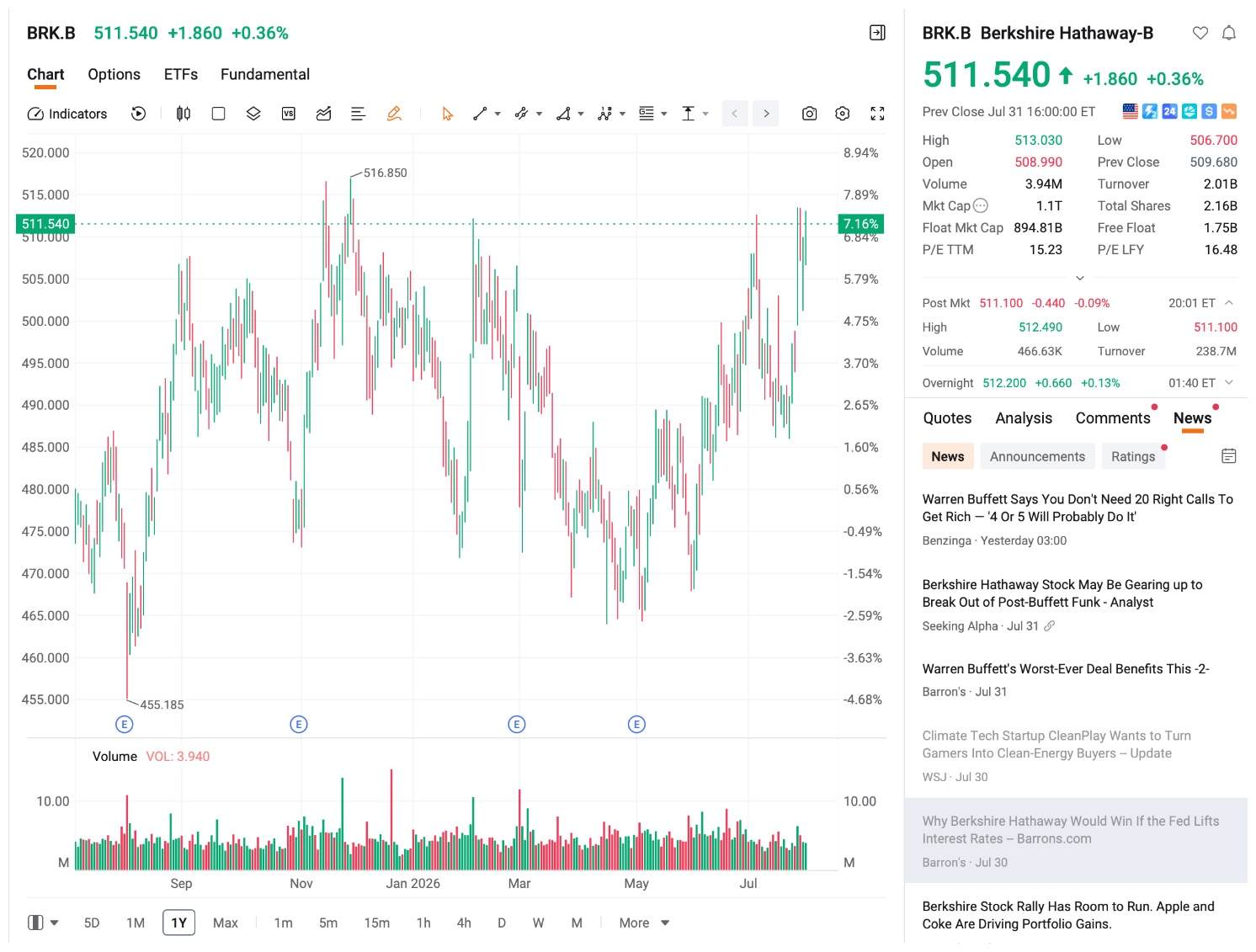
[Source: Futu]
The immediate driver pushing the stock price upward came from three major holdings in its public equity portfolio. Apple ( AAPL) has risen by over 13% year-to-date, with its holding market value exceeding $70 billion. Ranking among the top positions in the portfolio, it contributed the major portion of the net asset value growth. Coca-Cola ( KO) soared 25% year-to-date, while Bank of America ( BAC) has gained more than 12%.
However, in terms of contribution, Apple's role was the most prominent. Since its weight in the public equity portfolio is approximately 20%, it made the largest contribution to the overall increase in net asset value even though its gain was not as high as Coca-Cola's. Although Coca-Cola and Bank of America performed stronger, their relatively lower weights meant they had a limited marginal boost to overall returns.
As of late July, Berkshire's stock price had risen about 2.21% year-to-date, compared to a gain of about 9.4% for the S&P 500 Index over the same period, leaving a gap of around 7 percentage points between the two.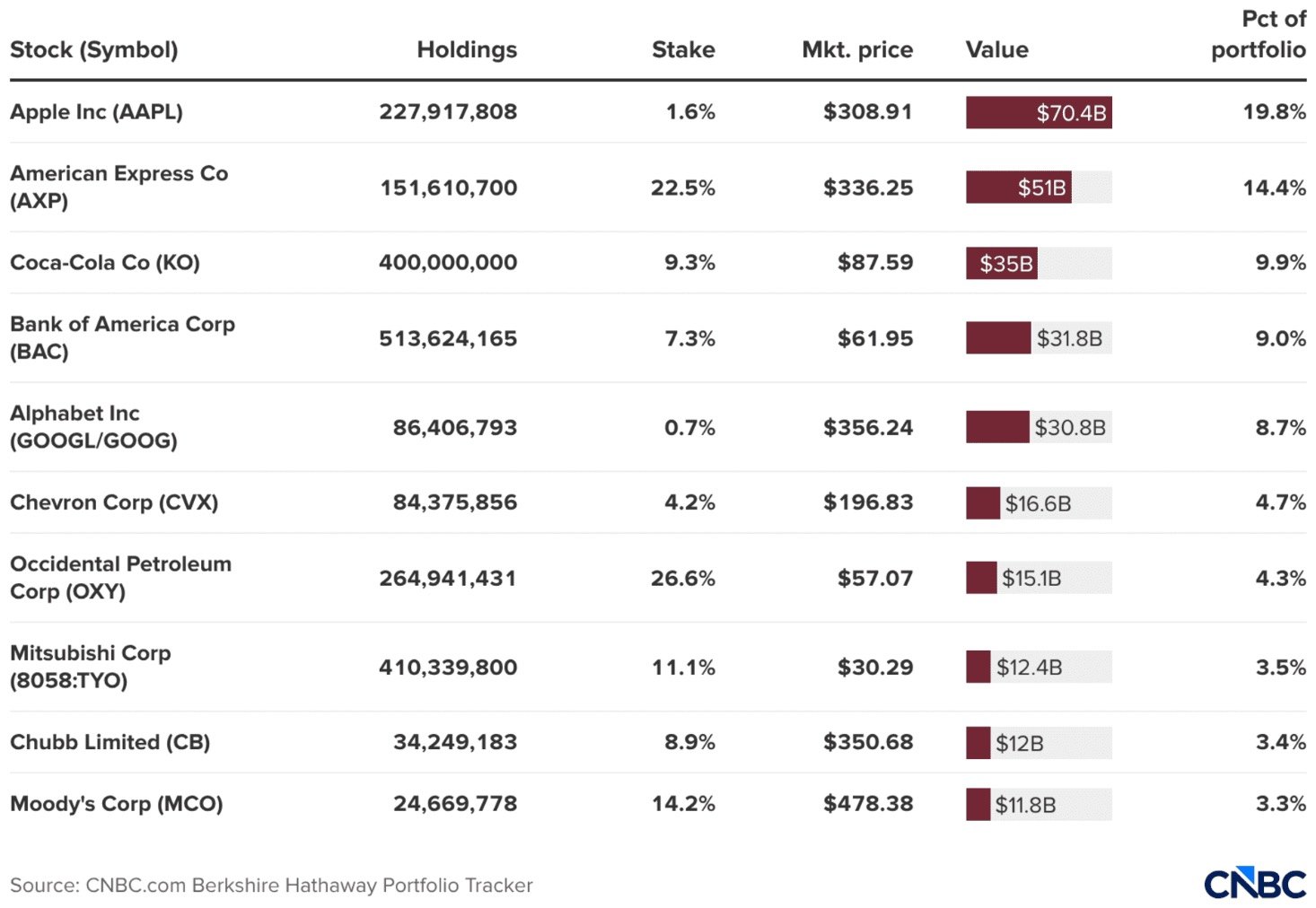
[Source: CNBC]
Abel has also been actively adjusting the investment portfolio since taking office. Berkshire recently completed two major moves, including the $8.5 billion acquisition of homebuilder Taylor Morrison ( TMHC) and increasing its stake in Alphabet ( GOOGL / GOOG) to approximately $31 billion, making it the fifth-largest holding in the investment portfolio.
Notably, Buffett explicitly stated in a recent interview with CNBC that he personally initiated the position in Alphabet. He admitted to regretting not buying the tech giant earlier and believes Alphabet's chances of winning the AI wave are higher than over 90% of the targets hyped by Wall Street.
The market widely believes that these two investments reflect the differing focus areas of the new and old management. Taylor Morrison continues Berkshire's long-term investment logic of being bullish on the U.S. residential market, while the substantial increase in the Alphabet position signifies that the company is further expanding its technology sector allocation beyond Apple, transitioning toward a diversified layout.
Buffett has also previously stated that AI competition requires hundreds of billions of dollars in capital investment, and this type of asset-heavy, high-cash-flow business model aligns perfectly with Berkshire's consistently preferred investment framework.
UBS analyst Brian Meredith raised his price target on the Class B shares this week to $585 from $570 while maintaining a 'Buy' rating. Barron's also previously published an article noting that Berkshire's stock price still lags the S&P 500 Index year-to-date, indicating room for a catch-up rally.
However, whether these optimistic expectations will materialize depends heavily on the recovery of its two major businesses: insurance and railroads. In the fourth quarter of last year, insurance underwriting profit plunged by 54%, and rail freight is also under pressure from weak industrial demand. The performance of these two businesses will directly affect the market's assessment of Abel's operating capability.
As of the end of the first quarter this year, Berkshire's cash on hand reached $397.4 billion, hitting another record high. How to allocate this massive cash pile remains the most pressing question for investors.
Among all uses of capital, share buybacks often best reflect management's judgment of the company's valuation. Generally speaking, an expansion in the scale of buybacks indicates that management believes the current stock price is attractive.
First-quarter buybacks were only $234 million, the lowest in recent years, while Barron's previously estimated based on the reduction in outstanding shares that second-quarter buybacks could be as high as $11 billion. Beyond the specific buyback amount, the market is more focused on the signal sent behind it: how the new management weighs buyback prices against capital deployment intensity.
The August 8 earnings report is only the first observation point. A complete market judgment of Abel may require two to three quarters of data to gradually take shape.
Find out more
Comments