Last Friday, the three major U.S. stock indexes closed down across the board. The Dow fell 0.51%, the S&P 500 fell 1.07%, and the Nasdaq closed down 1.69% for weak performance.
Cloud computing giant Oracle Bone Inscriptions (ORCL) 's stock price plummeted 12% due to lower-than-expected earnings guidance and a sharp increase in capital expenditure forecast, directly dragging down the entire AI computing power sector. As the core supplier of the AI industry chain,$Nvidia (NVDA) $Highly linked with the capital expenditure of cloud vendors. Oracle's pessimistic guidance has raised market concerns about a short-term peak in demand for AI infrastructure, leading to capital outflows from the semiconductor sector. Chip stocks such as Broadcom and Micron all fell more than 2% that day.
Despite short-term pressure, Nvidia's long-term logic has not fundamentally changed.
The demand side remains strong: It is reported that Nvidia is evaluating increasing H200 chip production due to strong demand in the Chinese market. Global semiconductor sales exceeded US $200 billion for the first time in the third quarter, and demand for AI chips is still the core driving force.
Industry leadership and strategic layout: The company actively responds to the bottleneck of AI development, and plans to hold a summit to discuss how to solve the power shortage problem and build a more stable ecosystem.

Nvidia Bull Put Spread
1. Strategy structure
Investors build a on NVDABull Put Spread, consisting of two Put options with the same expiration date:
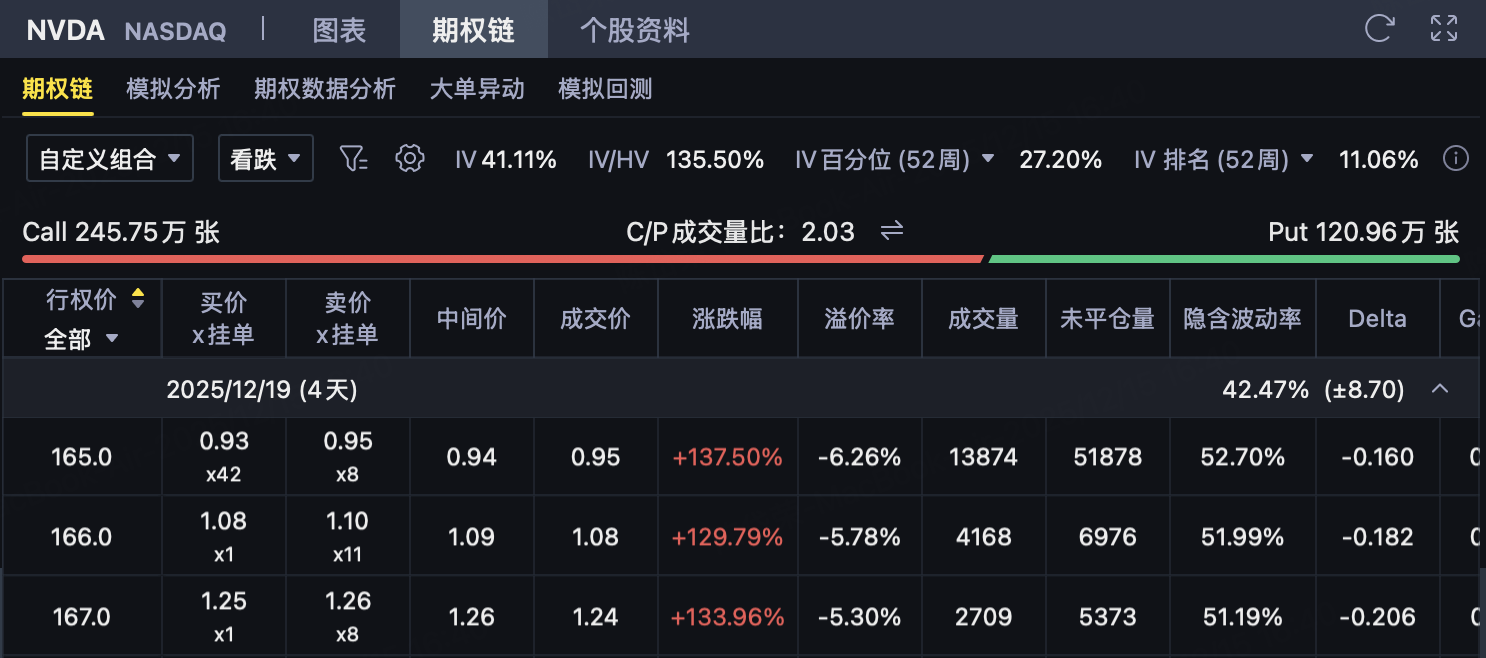
Sell higher strike price Put: K ₂ = 170, premium revenue $1.92
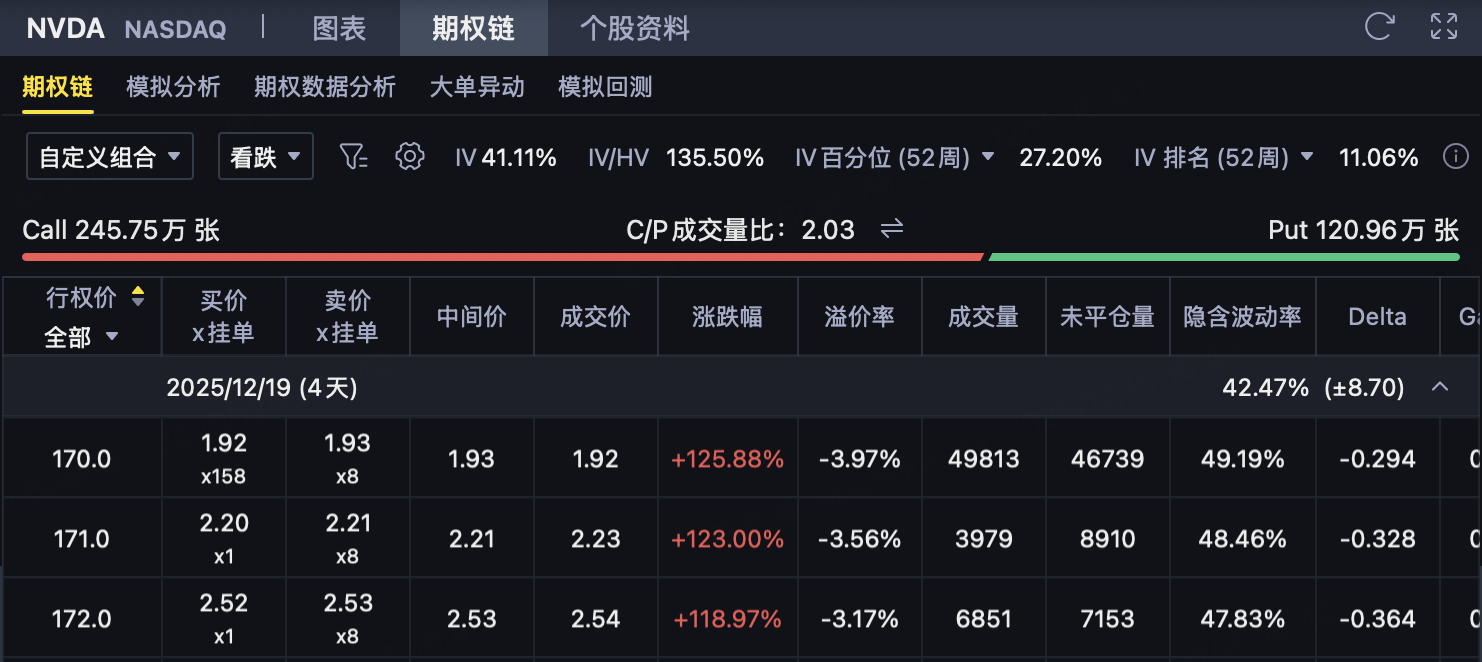
Buy lower strike Put: K ₁ = 165, premium spend $0.95
The strategy belongs toCharge premium, too muchThe spread combination. Investors expect NVDA at expirationGo up or stay above higher strike price (170); Looking to obtain time value gains in a limited risk manner.
Initial net income
Net premium (per share)
= 1.92 − 0.95
= $0.97/share
1 mouth = 100 strands, therefore:
Total net income
= 0.97 × 100
= $97/contract
This is what investors get when they open positionsMaximum potential profit。
3. Maximum profit
When the NVDA expiration price is ≥ $170, both Put shares are out-of-the-money, and the spread is all returned to zero:
Strike spread
= 170 − 165
= $5/share
Maximum profit (per share)
= Net premium received
= $0.97/share
Total maximum profit
= 0.97 × 100
= $97/contract
4. Maximum loss
The maximum loss occurs when the spread is fully triggered, that is, when the NVDA expiration price is ≤ $165:
Maximum loss
= Strike spread − Net income
= 5 − 0.97
= $4.03/share
= $403/contract
Happens at:
When the NVDA expiration price is ≤ $165, both Put shares are in-the-money, and the full price difference incurs a loss.
5. Break-even point
Break-even point
= K ₂ − Net income
= 170 − 0.97
= $169.03
Maturity judgment rules:
≥ $169. 03 → Investor Earnings
= $169.03 → Flat
≤ $169.03 → investor loss
6. Risk and return characteristics
Maximum gain: $97/contract (limited)
Maximum loss: $403/contract (limited)
Profit-loss ratio: gain: loss = 97: 403 ≈ 1: 4.15
Applicable scenario: Investors expect NVDA before expiration dateStay above 170 or fall slightly, hoping to collect time value by selling high strike price Put, while limiting potential risks with lower strike price Put.
Comments