


Shares of Micron Technology fell 3.78% on Thursday to close at $444.27. For the quarter ended Feb. 26, the company reported revenue of $23.86 billion, sharply higher than $8.05 billion a year earlier, driven by robust demand for memory chips used in artificial intelligence systems. Tight supply and increasing demand for higher-capacity memory in advanced computing have continued to support pricing.
Despite the strong results, Micron raised its fiscal 2026 capital expenditure outlook to $25 billion from $20 billion and signaled further growth into 2027. The prospect of heavier spending, combined with the industry’s cyclicality, appears to have raised investor concerns about margins, weighing on the stock even after upbeat earnings.
Options Market Analysis
Micron’s options market has turned notably active and complex following the recent pullback in its share price. Options data point to significant divergence among institutional investors over the near-term outlook, alongside broad hedging activity against medium-term risks.
1. Implied Volatility and Market Sentiment
Implied volatility (IV) for MU options currently stands at 69.37%, a moderately elevated level (65.34th percentile), suggesting options are not cheap. Meanwhile, the put-to-call volume ratio is at 1.24, indicating a defensive or cautious tilt in market sentiment.
2. Open Interest Structure and the “Put Wall”
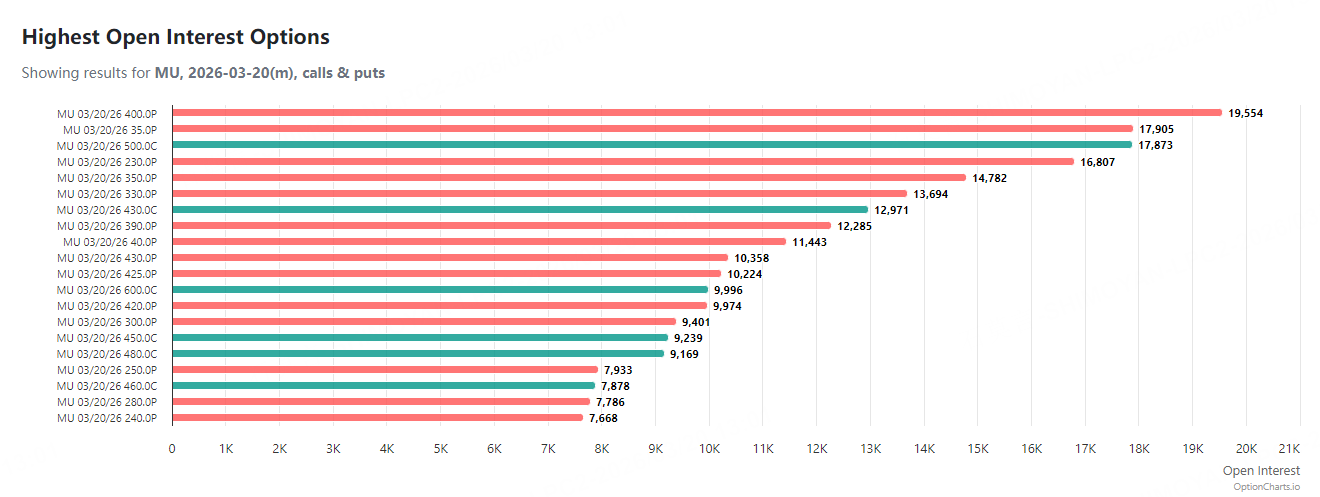
In the options chain expiring March 20, 2026, the $400 strike put holds the largest open interest, with 19,554 contracts outstanding. As a deep out-of-the-money option, such a concentration typically signals substantial demand for downside protection below this level or aggressive put-selling strategies.
This clustering effectively forms a notable “put wall,” which could act as a key psychological and technical support level going forward.
3. Block Trades Highlight Intense Bull-Bear Tug of War
Recent large options trades underscore sharply differing views on both short- and medium-term price action:
Heavy long-dated downside bets:
The most striking trade was the purchase of 7,035 contracts of $400 strike puts expiring Sept. 18, 2026. This sizable position reflects a clear medium- to long-term bearish or hedging stance, potentially by institutions seeking protection or by speculative investors positioning for a significant correction over the next six months.
Source: Tiger Trade App
Concentrated mid-term protection:
In addition to long-dated puts, investors have actively built near- to mid-term downside hedges. Notably, 9,600 contracts of $420 strike puts expiring April 24, 2026 were bought, reinforcing concerns over price weakness in the next one to two months.
Source: Tiger Trade App
Short-dated deep OTM positioning:
In near-term contracts approaching expiration, there has been intense activity in deep out-of-the-money puts around the $500 strike region. For instance, traders sold 3,790 contracts at the $502.5 strike and 2,040 contracts at the $550 strike—positions consistent with a short strangle strategy, betting the stock will not collapse in the short term. At the same time, 2,050 contracts of $517.5 puts were bought, suggesting hedging or directional counter-bets.
This direct confrontation at extreme strike levels highlights substantial disagreement among institutional players over the stock’s short-term trading range.
Source: Tiger Trade App
Conclusion and Strategy Takeaways
Overall, sentiment in Micron’s options market appears cautious, with intense positioning on both sides. While short-term trading reflects a mix of neutral strategies and offsetting hedges, demand for downside protection over the medium term (one to six months) is notably strong.
Investors should closely monitor price action around key strike levels at $400, $420, and $500. Options strategies such as selling out-of-the-money puts or calls beyond these levels may offer opportunities to collect premium, depending on individual risk tolerance.
Disclaimer: Options trading involves significant risk. The above analysis is for informational purposes only and does not constitute investment advice. Investors should fully understand the characteristics of options and assess their own risk tolerance before trading.
