


Hang in There for Another Week
There are two weeks left until the "Triple Witching Day" on March 21, when a large number of options will expire. As shown in the chart, NVIDIA's open interest ranked by quantity highlights March options in yellow.
Based on the current stock price of 111, most of the leading March call options have almost entirely lost value and become worthless. In contrast, many put options retain value, forming a sharp contrast.
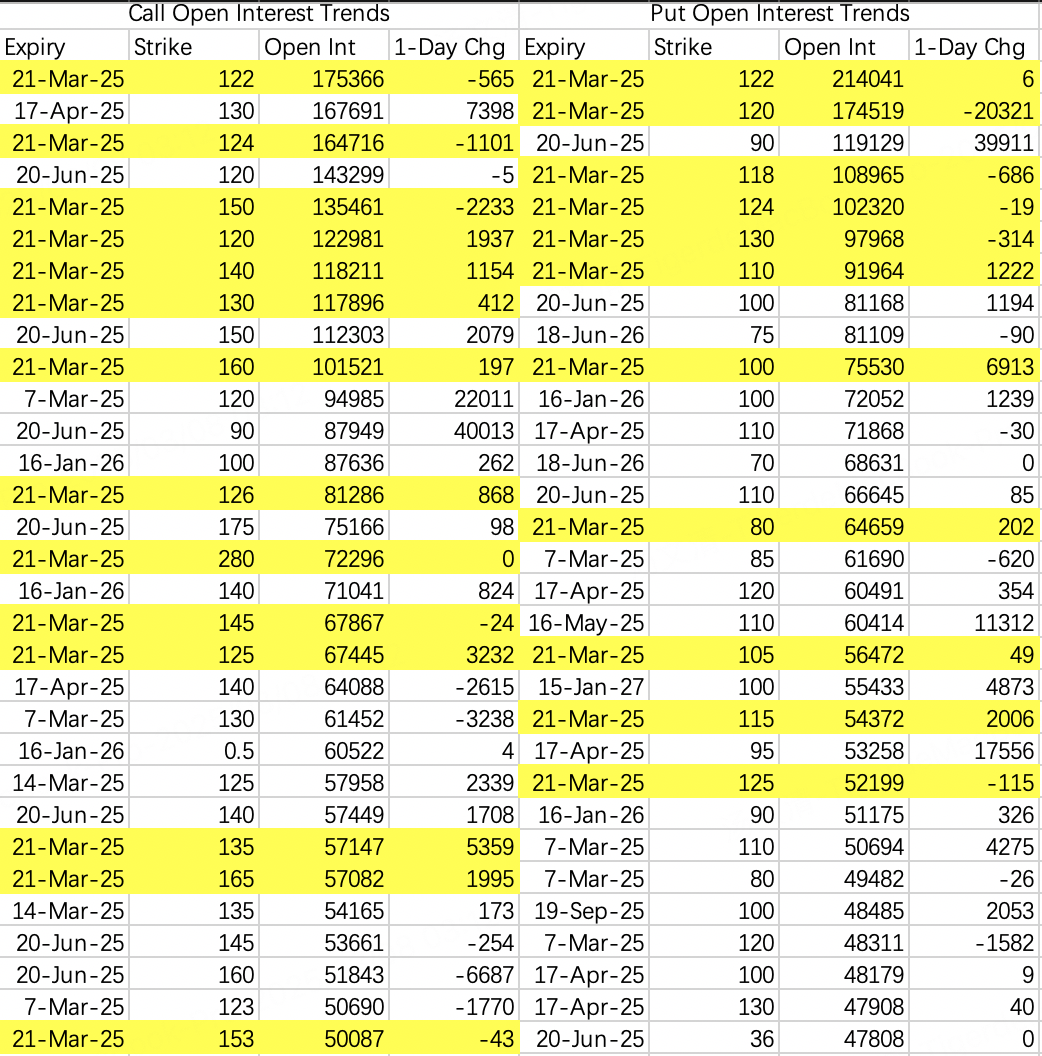
Theoretically, some puts will also lose value, but as it stands, next week will likely continue to put pressure on call options.
Ranked by open interest, the bullish sentiment on Thursday was not as strong as on Wednesday. Institutions continued to sell calls and roll their positions, believing that during the week of March 14, the stock price is highly likely to stay below 117 or 121.
Put option open interest is less organized compared to call options, but this doesn’t mean there won’t be a sell-off. On the contrary, many traders are betting on a black swan event causing a cliff-like drop.
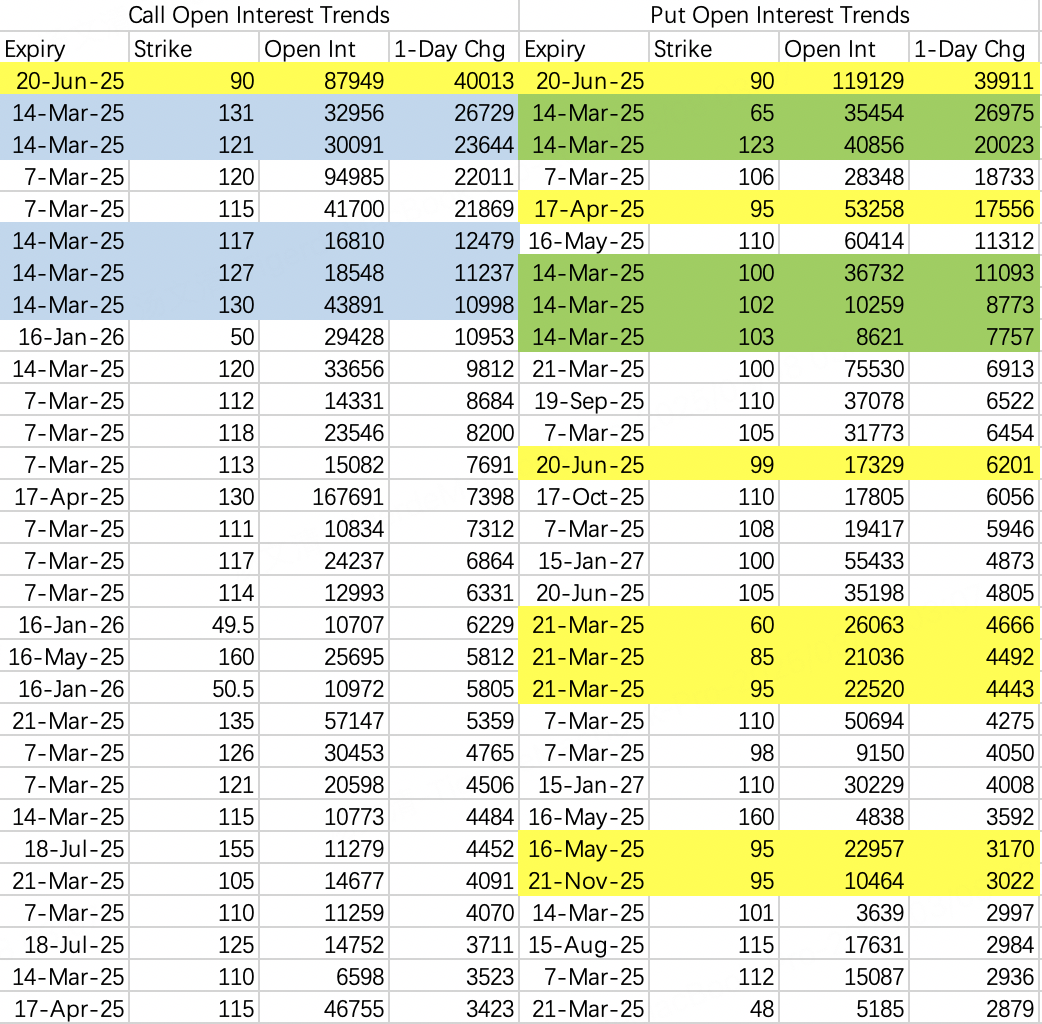
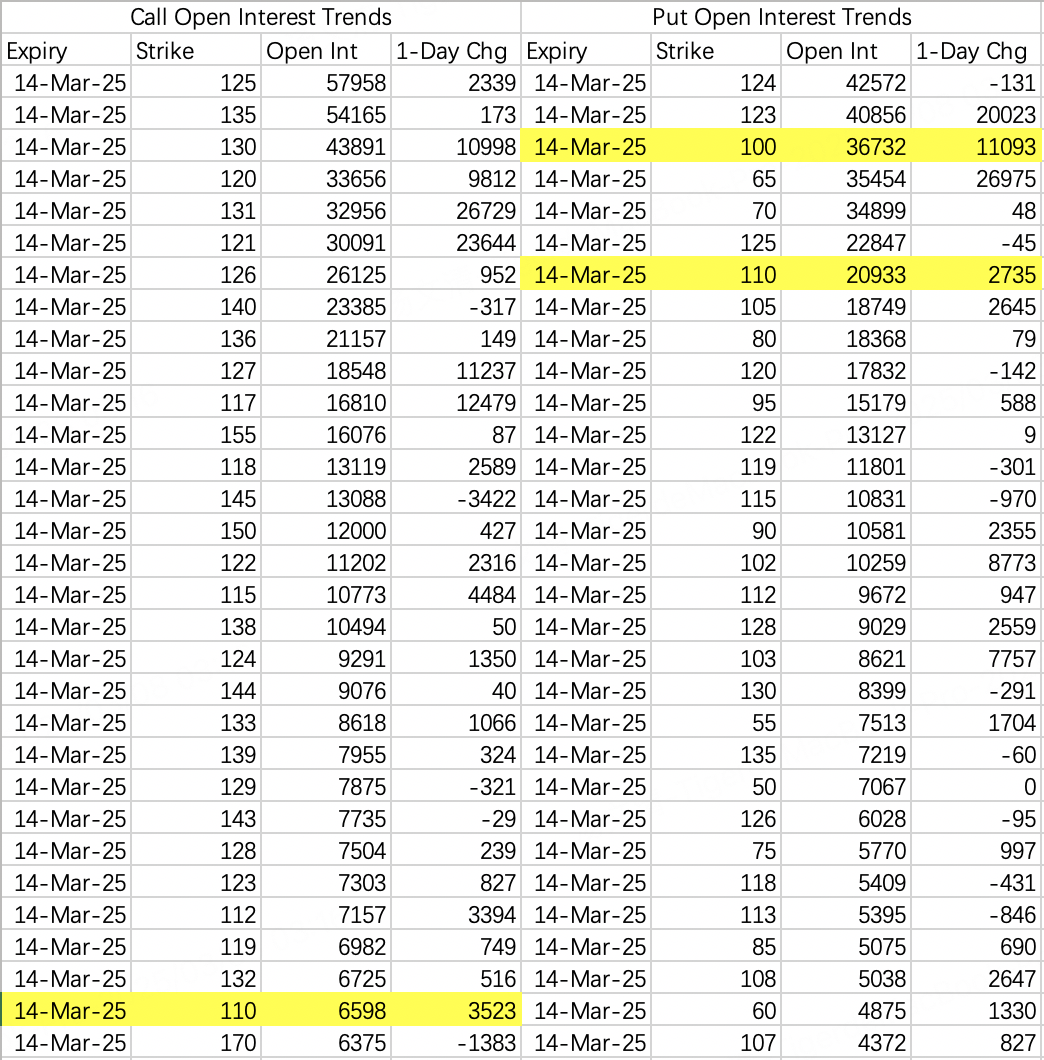
Open Interest for Expiring Options Next Week
Call options are expected to lose all value, while puts are priced with very low expectations. Friday’s large stock price swings suggest that put open interest may increase further.
If a black swan event occurs next week, the stock could hit 100. Without it, the price may fluctuate between 110 and 120.
Thoughts on Deep Out-of-the-Money Puts
Looking at data for long puts with strike prices like 90, 80, or even 70, NVIDIA's bullish and bearish sentiment is as divisive as Tesla's.
There’s been a flood of recent news, such as reports of CoWoS order cuts, internet giants halting procurement, and Huawei’s extremely low-cost chip computing power—all negative factors. Some of these rumors have been clarified by management, such as the CoWoS order cuts. However, others could pose a real threat to NVIDIA’s moat, like Huawei’s chip R&D progress. A year ago, I might not have paid attention to this, but after the DeepSeek incident, it’s hard to ignore.
After reviewing some analysis reports, I’ve come to the following conclusions:
The AI market is still expanding, and the pie is growing enough to share.
NVIDIA’s stock price at 111 remains relatively low compared to the year-end minimum expectation of 146.
Investor Duan Yongping has sold 110 puts.
Based on these three reasons, I think the current price is acceptable. Of course, a black swan event dropping the price to 90 is possible, but it may not happen. To guard against a sharp drop, protective measures can be put in place.
Barclays Analyst Report Summary on AI Prospects
Next Phase of AI Semiconductors: Inference
The AI model computing market is undergoing a paradigm shift from pre-training expansion to post-training expansion.Post-Training Expansion Reduces Computing Demand Concerns
Although computing demand decreases compared to pre-training expansion, the frontier AI computing market is expected to grow at a 55% compound annual growth rate (CAGR), reaching over $800 billion in chip spending by 2028.Industry Still Faces Computing Resource Shortages
Capital expenditure on AI chips for frontier AI models is estimated to grow 13x year-over-year in 2025, with a 55% CAGR expected to reach hundreds of billions of dollars by 2028.NVIDIA Remains the Leading Chip Supplier
NVIDIA is expected to maintain nearly 100% market share in frontier AI training and secure approximately 50% of inference FLOPs in the long term.Custom ASIC Market for AI Inference Continues to Expand
Custom ASICs will account for nearly half of inference FLOPs in the long term, with chip spending expected to reach $155 billion by 2027 and exceed $190 billion by 2028.Demand for Training FLOPs Shifting from Pre-Training to Post-Training
Post-training techniques, especially reinforcement learning/inference, introduce significant computational costs that will eventually surpass pre-training.Shift from Dense Models to Sparse Models
This transition reduces activation parameters, offsetting the increase in computational usage for inference/CoT workloads.New Cost Models Allow More Developers to Enter the AI Space
New algorithmic efficiencies are an essential step forward for the industry, as increasing development costs could hinder further innovation.Greater Focus on Inference
The democratization of AI applications is becoming increasingly evident, driving higher computational demands for inference.Chip Companies Will Prioritize Three Factors
Greater support for low-precision types
Higher availability and bandwidth for on-chip memory
Better inter-chip networking capacity
Disclaimer: Investing carries risk. This is not financial advice. The above content should not be regarded as an offer, recommendation, or solicitation on acquiring or disposing of any financial products, any associated discussions, comments, or posts by author or other users should not be considered as such either. It is solely for general information purpose only, which does not consider your own investment objectives, financial situations or needs. TTM assumes no responsibility or warranty for the accuracy and completeness of the information, investors should do their own research and may seek professional advice before investing.
- Tiger_CashBoostAccount·2025-03-10Great job on your latest stock market success! Your commitment to research and analysis is evident in your results.Trade with Tiger Cash Boost Account and use contra trading toenhance your strategies."Welcome to open a CBAtoday and enjoy access to a trading limit of up to SGD 20,000with upcoming 0-commission, unlimited trading on SG, HKand US stocks. as well as ETFs.
- How to open a CBA.
- How to link your CDP account.
- Other FAQs on CBA.
- Cash Boost Account Website.
LikeReport - How to open a CBA.
- EraGrowth_Wealth·2025-03-10great opportunityLikeReport