


Don’t Get Too Excited About Large Trades—It Could Be a Trader’s “Fat Finger”
This is a casual essay, chatting about two recent examples of errors in large options trades.
Errors in placing orders are often called "fat fingers," a vivid term that describes pressing the wrong key due to a finger being too big.
One famous fat finger case occurred in 2001 when UBS sold 610,000 shares of Dentsu at 6 yen per share instead of selling 6 shares at 610,000 yen each. Although the mistake was immediately discovered, the Tokyo Stock Exchange did not cancel the transaction, forcing UBS to repurchase the shares at market value, resulting in a $100 million loss.
I wanted to discuss this because there has been significant market volatility recently, and when you see unusual large options trades, don’t rush to follow them. There’s a very small chance that the trader simply made a mistake.
How to Identify a Fat Finger Error?
It’s simple—check three things:
Open Interest Data: Open interest updates before the market opens the next day. If the open interest is less than the trade volume of the large order, it’s likely a fat finger trade that was canceled, although the candlestick chart has already formed and cannot be redrawn. Always rely on open interest data.
Daily Volume in the Option Chain: While candlestick charts may show high volume, the option chain records the actual daily trade volume, which will be much lower if it was a fat finger trade.
Intraday Chart: After open interest data updates, you can check the intraday chart. If a large trade is followed by a smaller one, it’s likely the incorrect order was canceled and replaced by the correct one.
Interestingly, I recently discovered two examples of fat finger errors in large options trades, both involving $China Large-Cap ETF-iShares (FXI)$.
First Example: February 28, 2:07 PM
An unusual large bullish spread trade was detected, where someone bought 110,000 contracts of the $34 call and sold 220,000 contracts of the $40 call.
Opened a position by buying $FXI 20250620 34.0 CALL$ .
Opened a position by selling $FXI 20250620 40.0 CALL$ .
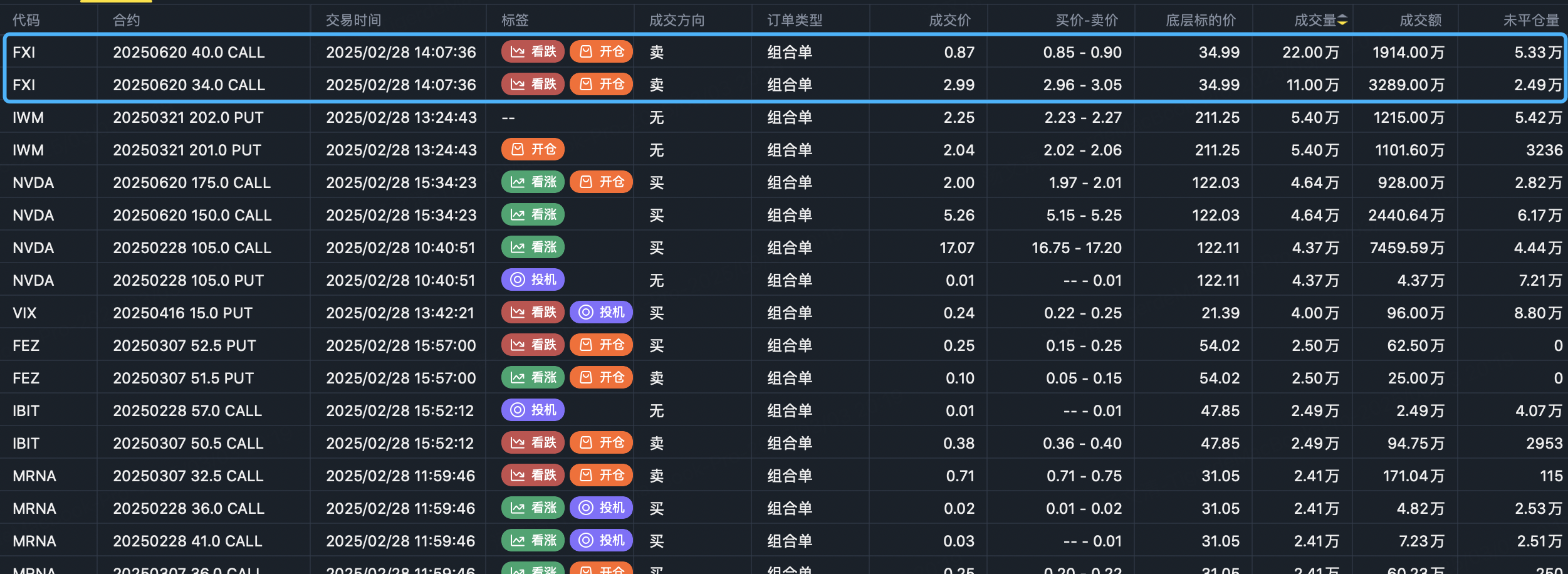
(Since this is a casual post, I’ll explain for beginners: U.S. stocks can be short-sold, and U.S. options can also be short-sold. Specifically, you can click "sell" on an underlying without holding it, and your position will display as a negative number, indicating a successful short sell. Therefore, "sell" and "buy" here do not represent a sequence; they are simultaneous trades in two different options contracts.)
When checking the daily volume in the option chain:
The $40 call had a daily volume of only 20,000 contracts.
The $34 call had a daily volume of only 10,000 contracts.
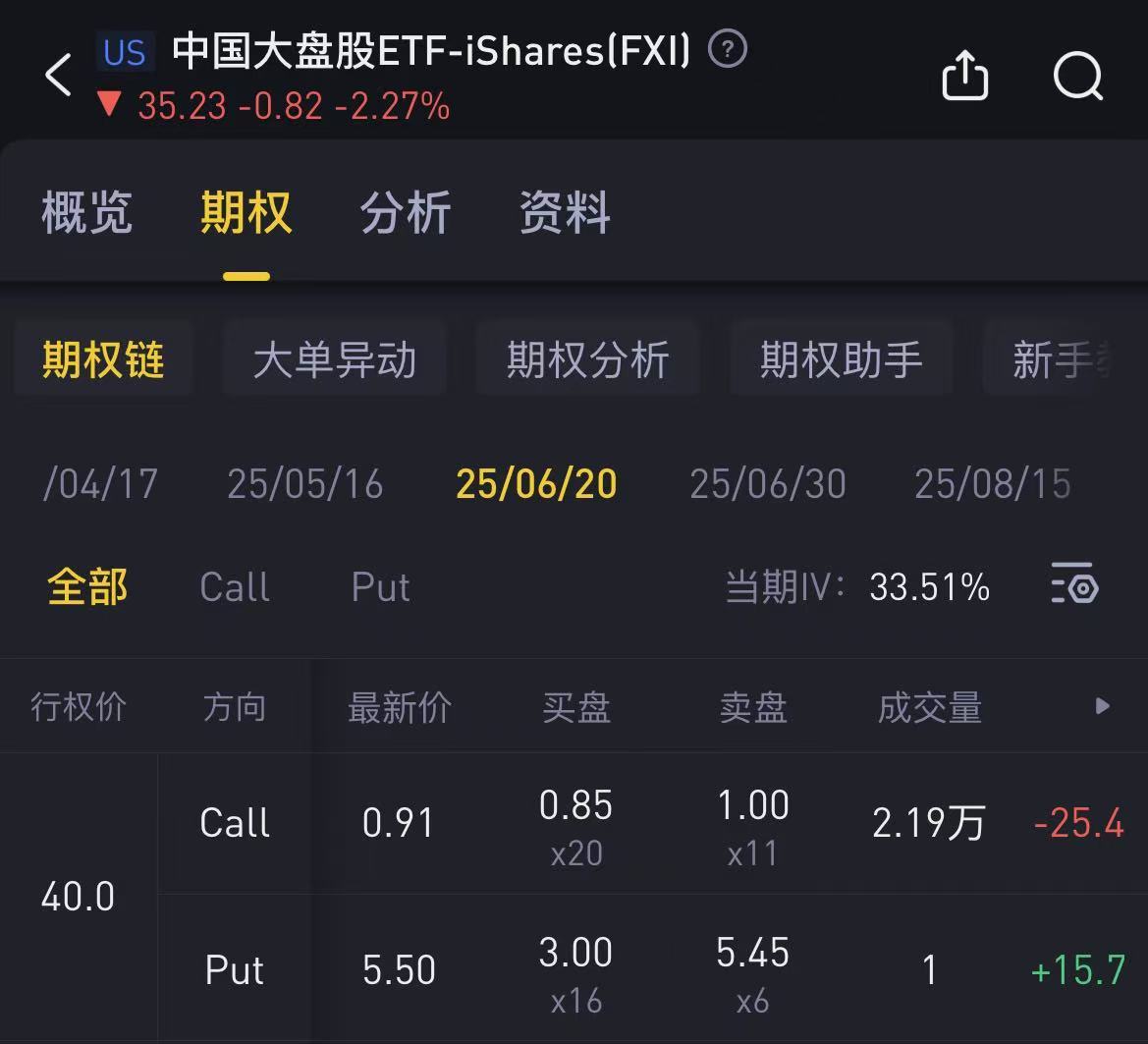
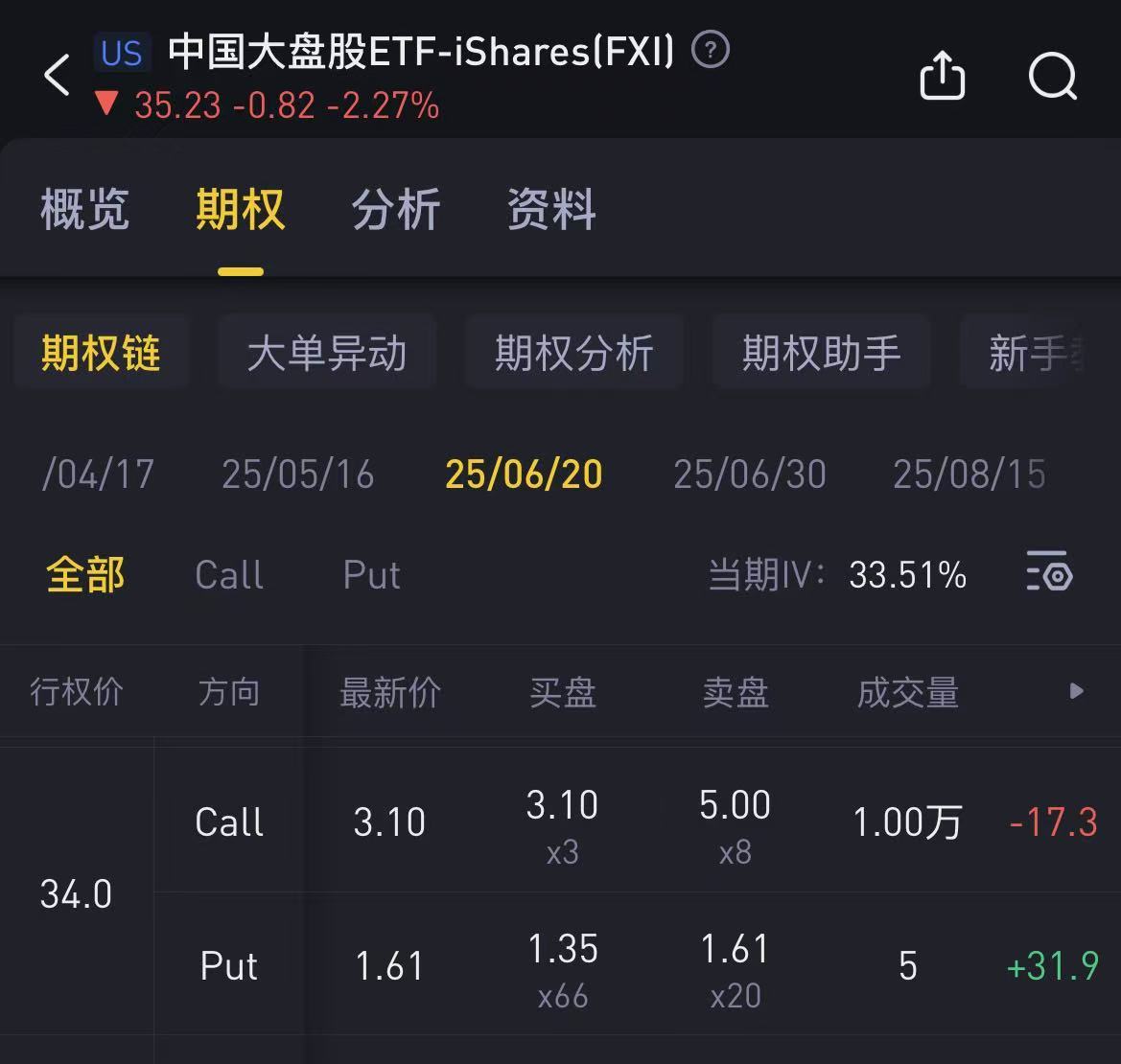
This means the actual trade was buying 10,000 contracts of the $34 call and selling 20,000 contracts of the $40 call. The trader had clearly pressed an extra digit by mistake.
Second Example: March 10, 10:08 AM
An unusual large bearish spread trade was detected, where someone bought 30,000 contracts of the $36 put $FXI 20250516 36.0 PUT$ and sold 90,000 contracts of the $33 put $FXI 20250516 33.0 PUT$ .

However, checking the option details page, the open interest for the $33 put $FXI 20250516 33.0 PUT$ was only 38,200, far below the 90,000 contracts claimed in the trade.
The intraday chart shows a long spike followed by a short one, indicating that the second, smaller trade was likely the correct order.
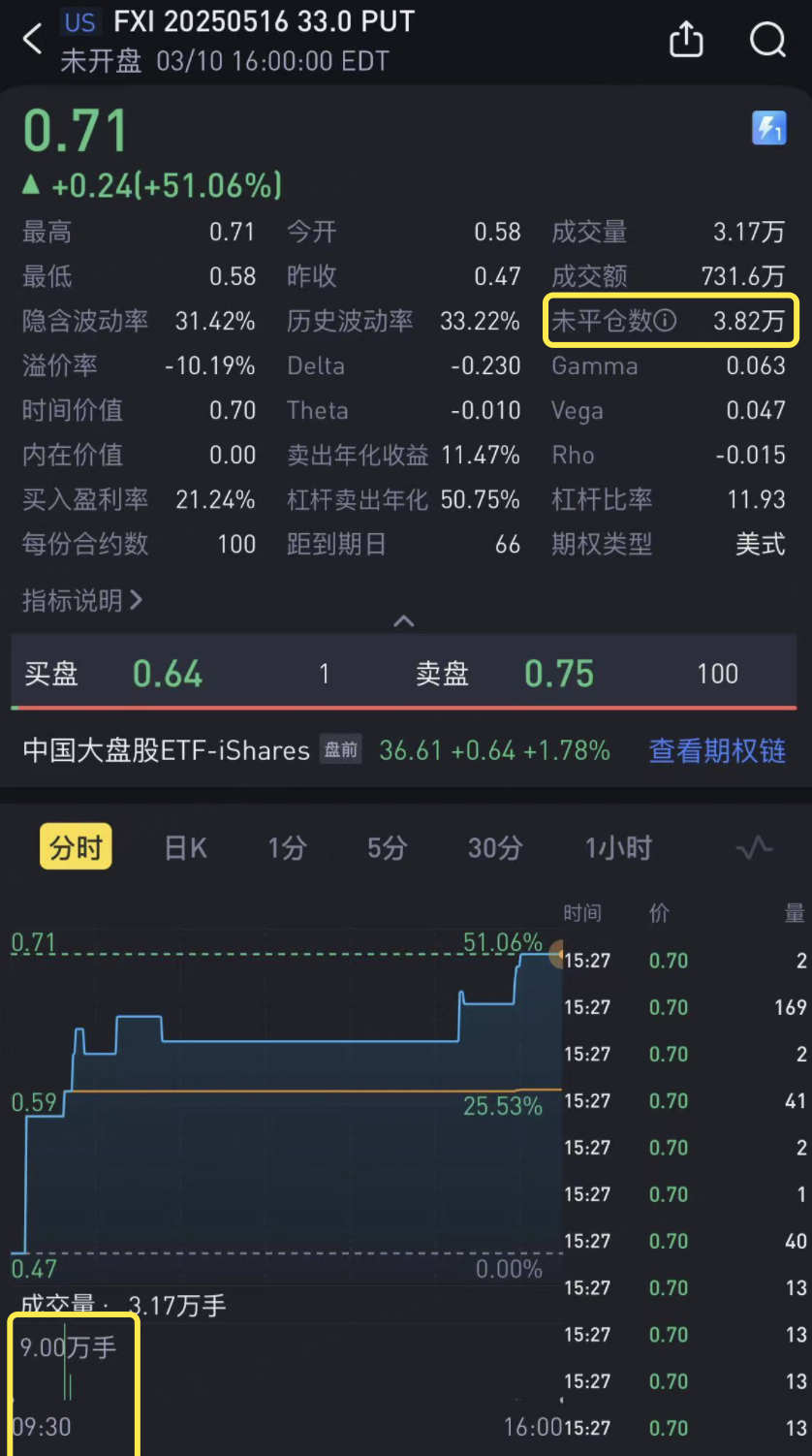
This means the actual large trade was buying 10,000 contracts of the $36 put $FXI 20250516 36.0 PUT$ and selling 30,000 contracts of the $33 put $FXI 20250516 33.0 PUT$ .
Compared to the previous example, which involved pressing an extra digit, this case highlights a multiplication error. Perhaps the trader misheard the number "three times as many."
Conclusion
Whenever you see a large trade exceeding 100,000 contracts, try not to get too excited. Always verify the daily volume in the option chain and the open interest data. Although it’s a very small probability, it could be a fat finger error.
Disclaimer: Investing carries risk. This is not financial advice. The above content should not be regarded as an offer, recommendation, or solicitation on acquiring or disposing of any financial products, any associated discussions, comments, or posts by author or other users should not be considered as such either. It is solely for general information purpose only, which does not consider your own investment objectives, financial situations or needs. TTM assumes no responsibility or warranty for the accuracy and completeness of the information, investors should do their own research and may seek professional advice before investing.
