


The crash of Japanese bonds has pushed U.S. bonds to plummet. Is it time to buy the bottom?
The most striking thing about the global bond market this week is not the surge in U.S. debt, but the violent shock in the Japanese Treasury Bond market. The latest research report from Goldman Sachs reveals that the "crash-like" rise in Japanese long-term Treasury Bond yields is actually the driving force behind the sharp drop in U.S. debt.
On the 24th, according to news from Zhuifeng Trading Desk, Goldman Sachs believed that,The core reason for the surge in Japanese long-term Treasury Bond yields is the severe imbalance between supply and demand.The sharp drop in demand from life insurance companies due to the widening duration gap, coupled with the increasing government financial worries and the sell-off triggered by asset-intensive reinsurance transactions, have jointly built the selling pressure of the long-term Treasury Bond market. These factors lead to the scarcity of buyers and extremely poor liquidity in Japan's Treasury Bond market. Even if the Bank of Japan holds a large amount of Treasury Bond, it can't recover.
Goldman Sachs also stressed that although the Japanese Treasury Bond sell-off has not yet been transmitted to the Japanese stock market or foreign exchange market, its spillover effect on the global bond market has become increasingly significant. The data shows that since the beginning of this year, the 30-year Japanese Treasury Bond has contributed about 80 basis points of upward pressure to the yields of G4 (US, Europe, Japan, and UK) countries, becoming the biggest source of bearish momentum.This means that the surge in US Treasury Bond yields in the past month is likely to be mostly a "by-product" of the long-term Japanese Treasury Bond market turmoil.
Looking ahead, volatility in the Japanese Treasury Bond market will continue. Although the Japanese government may consider reducing long-term Treasury Bond issuances or buybacks, Goldman Sachs believes that such volatility will repeat without substantial macroeconomic policies to deal with high inflation.The direction of the Bank of Japan's monetary policy, especially the adjustment of its quantitative tightening path, will become the key to influencing the market trend in the short term.
Why are Japanese long-term Treasury Bond yields soaring?
Yusuke Ochi, Japan interest rate trader at Goldman Sachs, pointed out that Japan's long-term Treasury Bond yields have risen sharply recently,The main reason is the significant deterioration of the balance between supply and demand, which includes changes in the demand of life insurance companies and the tightening of the duration gap, and this trend is not a short-term phenomenon.
Goldman Sachs Japan interest rate strategist Bill Zu pointed out in the report that,The current yield level of the 30-year Japanese Treasury Bond is comparable to that of the 30-year German Treasury Bond, which rarely persists outside the effective floor period.
This sell-off has been relatively concentrated on longer-term Treasury Bond, resulting in a steepening of the 10-year vs. 30-year spread beyond its usual relationship to absolute yield levels. At the same time, Goldman Sachs' measurement of the 10-year term premium has not increased significantly, and the changes in the 2-year, 5-year and 10-year yields are far smaller than the average relationship with the 30-year yield.
The sell-off was exacerbated by technical and positional factors, including leverage to unwind positions and extremely illiquid demand for long-term Treasury Bond. Much of this has to do with the fact that the Bank of Japan holds 52% of Japan's Treasury Bond market.
It is important to note that the sell-off in 30-year Treasury Bond so far has not been accompanied by broader portfolio pressures in other Japanese assets, such as equities or currencies, in stark contrast to the US market. In the US, a Treasury Bond sell-off is usually accompanied by a weaker stock market and the dollar. This decoupling may suggest that the local weakness in the Japanese 30-year Treasury Bond may be temporary and may even reverse if technical and position tensions ease.
Global spillover effect: Japanese debt drags down U.S. debt
Goldman Sachs pointed out that the spillover risk of rising Japanese interest rates to global bond markets is a frequent question raised by clients. The evidence is mixed so far.
On the one hand, Goldman Sachs believes that technical factors are the main reason for the fluctuation of Japanese long-term Treasury Bond, which may mean limited impact on other markets. In addition, the common factor of G4 yield (the first principal component) has less explanatory power for the total variance of long-term curves (such as 10-20 years), indicating that the change of long-term yield is more special.
On the other hand, there is more evidence that Japanese long-term Treasury Bond is beginning to put more pressure on global long-term yields. Goldman's variance decomposition model shows that 30-year Japanese Treasury Bond has contributed about 80 basis points of upward pressure to G4 yields since the beginning of the year and is the largest source of bearish power within G4. Almost all of them have occurred since April 2, which may reflect a poor liquidity background, cautious risk-taking and heightened fiscal concerns (which are also reflected in other G4 markets).
This means that,Most of the recent selling pressure on U.S. Treasury Bond is actually not due to domestic factors in the United States, but a by-product of Japanese clearing of back-end positions.
For investors who want to buy TLT at the bottom, you can consider the diagonal spread strategy in options.
What is a diagonal spread?
diagonal spread refers to the spread established using options with different strike prices and different expiration dates. Generally, the duration of the long leg in the spread is longer than that of the short leg. Diagonal spreads include diagonal bull spreads versus diagonal bear spreads.
The diagonal bull spread is basically similar to the bull subscription spread strategy, except that it has been upgraded and improved again.The difference is that the two options for the diagonal spread have different expirations, the trader buys a longer-term call option with a lower strike price and sells a shorter-term call option with a higher strike price. The number of call options bought and sold is still the same.
TLT Diagonal Spread Case
Assuming investors are bullish for the next year$20 + + Years US Treasury Bond ETF-iShares (TLT) $, you can directly buy the call option with an exercise price of 87 and an expiration date of March 31, 2026. This option becomes our long leg, which costs $425 at the latest transaction price.
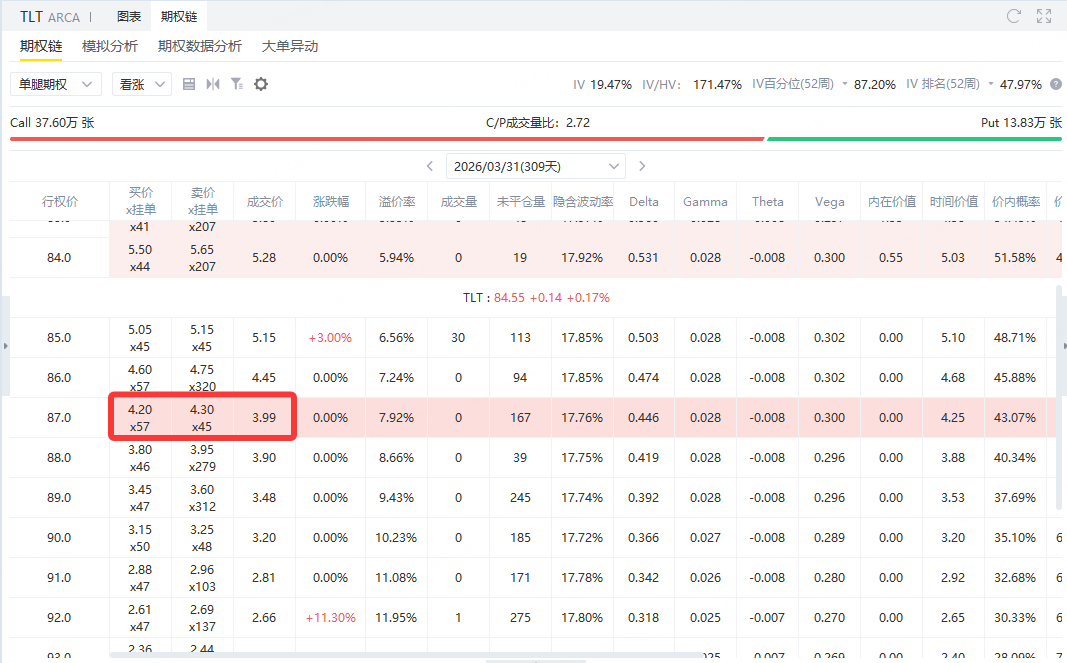
After the long leg is established, we can establish the short leg according to a shorter cycle than the long leg. Here, we can choose to establish it on a weekly basis. Choose to sell the call option with an exercise price of $88 and an expiration date of June 06 and get premium of $15.
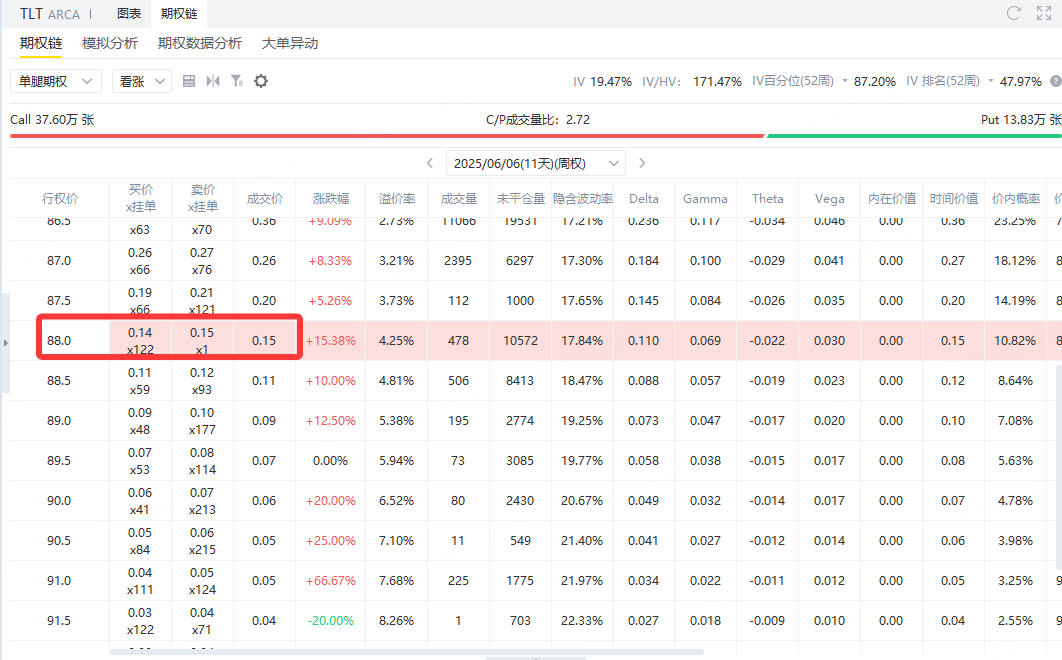
Here, if the call option sold is not exercised, it will generate a profit of $15, which is about 3.5% relative to the cost of $425 on the long side. However, the short leg can be executed once a week. When the remaining date of the long leg is as long as 309 days, investors can sell dozens of call options. If some sold call options can successfully obtain premium, it will greatly reduce the cost of buying the call option itself, and even get the call option for free.
Compared with buying bulls alone, the diagonal spread obtains an additional premium income, which reduces the overall net premium expenditure of the strategy, and the break-even point of the strategy is also shifted to the left, and the winning rate is also increased accordingly. AdditionallyThe selling point of the diagonal spread can be controlled by investors themselves, so different short-selling efforts can be selected in different cycles to facilitate investors to control risks. Diagonal spreadEssentially, it is a low-cost call option strategy that is worth investors studying.
Disclaimer: Investing carries risk. This is not financial advice. The above content should not be regarded as an offer, recommendation, or solicitation on acquiring or disposing of any financial products, any associated discussions, comments, or posts by author or other users should not be considered as such either. It is solely for general information purpose only, which does not consider your own investment objectives, financial situations or needs. TTM assumes no responsibility or warranty for the accuracy and completeness of the information, investors should do their own research and may seek professional advice before investing.
