


Nvidia fell again, how to operate tonight
For most of the past year,$Nvidia (NVDA) $The stock price continued to rise and reached the end of October $212All-time highs. However, affected by market concerns about changes in the competitive landscape of AI chips, stock prices have fallen significantly recently. On November 25, it once plummeted by more than 7% in intraday trading, and the market value instantly evaporated by about $350 billion, finally closed down 2.6%, hitting a two-month low. Overall, Nvidia's stock price has pulled back from its high point by about 16%, the market value evaporated by more than $800 billion。 This sharp decline shows that the market's high growth expectations for Nvidia are already fragile, and once negative news appears, it is easy to trigger large fluctuations.
The direct cause of the sharp drop in Nvidia's stock price was media reports Meta is considering deploying Google TPU starting in 2027, and may rent computing power through Google Cloud earlier. Google recently released the Gemini 3 model and led the industry in multiple tests, strengthening the technical strength of its self-developed TPU. As Google, Anthropic, etc. begin to adopt self-developed or Google-provided ASIC chips on a larger scale, the market is worried that the traditional dependence on Nvidia GPUs may change. TPUs have advantages in energy consumption and performance for specific AI workloads, and if more large model manufacturers adopt dedicated chips, the market share growth momentum of Nvidia GPUs will be squeezed.
Investors such as' Big Short 'Michael Burry have questioned Nvidia, specifically pointing to the gap between tech giants "Recycling transactions"(For example, Nvidia invests in OpenAI, OpenAI then purchases large quantities of Nvidia chips) is worrying, and it is believed that this mutual binding may cover up the real terminal demand. Burry also criticized Nvidia's equity dilution through stock-based compensation and the accounting treatment of chip depreciation cycles. These voices have exacerbated market concerns about a possible bubble in the AI industry, making investors more wary of the sustainability of Nvidia's growth.
Despite constant doubts from the outside world, Nvidia's fundamentals are still bright. Revenue in the third quarter of this year reached $57 billion, a year-on-year increase of 62%, and net profit increased by 65% year-on-year. CEO Huang Renxun emphasized that the current AI infrastructure has entered a "virtuous circle", and the growth of enterprises' demand for computing power is far from peaking. It is expected that in the next few quarters $500 billion revenue surgeWill be stronger than previously expected.
After the sharp drop in stock price triggered widespread discussion, Nvidia rarely publicly responded on social platforms, emphasizing that its GPU A whole generation ahead of the industry, currently has the only universal platform that can run all mainstream AI models and adapt to all computing scenarios. The company also emphasizes that compared with ASIC chips such as TPU, GPU has Greater versatility, ecological maturity, and substitutability。 This statement aims to reiterate to the market that even if competitors have advantages in some scenarios, Nvidia still has extensive ecological and flexibility advantages, which is the key source of its long-term competitiveness.
Bull Put Spread
1. Strategy structure
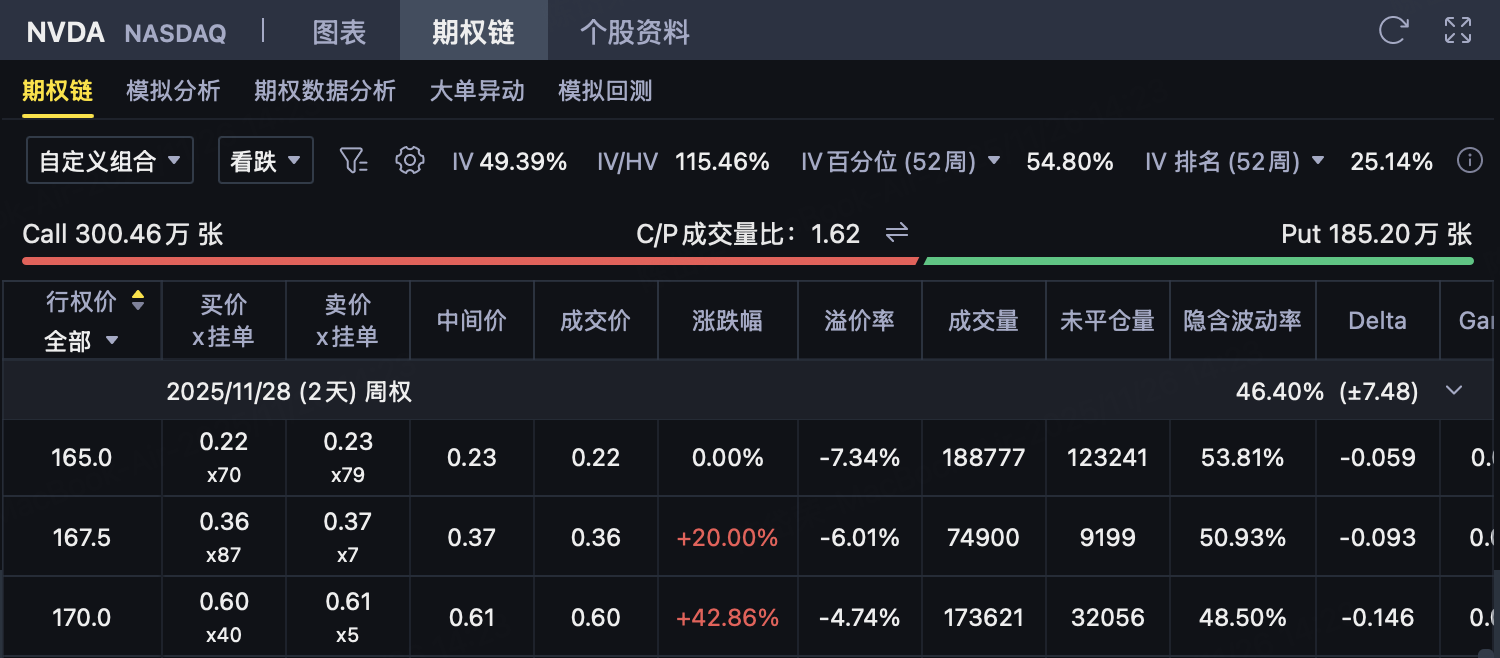
Investors Build A on Nvidia (NVDA)Bull Put Spread, consisting of two Put options with the same expiration date:
Sell higher strike price Put: K ₂ = 170, US stock premium income US $0.60
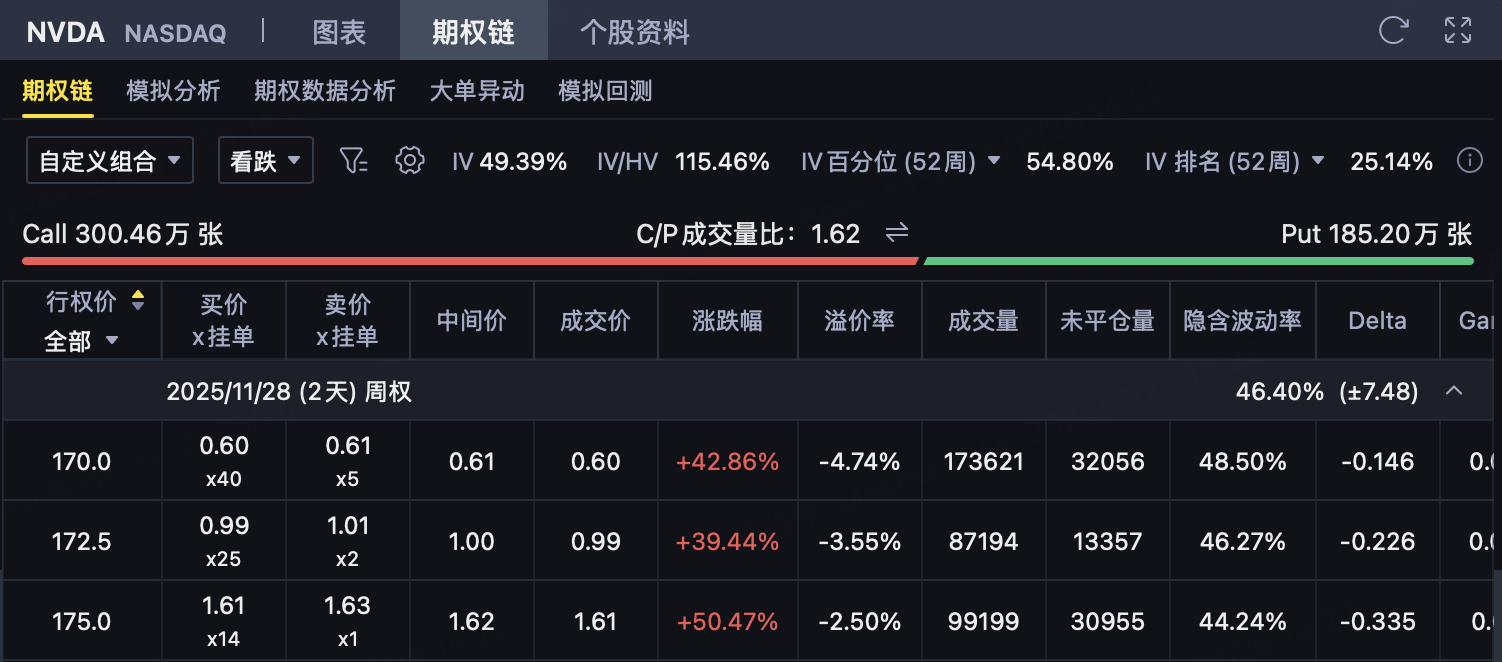
Buy lower strike price Put: K ₁ = 165, US stock premium spend $0.22
The strategy belongs toCredit type, moreInvestors want Nvidia's stock price to remain above $170 at expiration to maximize its gains.
Initial net income
Net premium (per share) = 0.60 − 0.22 =$0.38/Share
Because 1 mouth = 100 shares:
Total revenue = 0.38 × 100 =$38/contract
This is the maximum potential profit locked in when opening a position.
3. Maximum profit
When Nvidia reaches the future price≥ $170At that time, both Put shares are extra-price, and all premium income is retained.
Maximum profit =$38/contract
4. Maximum loss
When Nvidia reaches the future price≤ US $165At that time, both Put shares are in-the-money, and the spread is fully lost, but the investor retains the net income.
Strike spread = 170 − 165 =US $5/share
Maximum loss (per share) = 5 − 0. 38 =$4.62/Share
Total maximum loss = 4.62 × 100 =$462/contract
5. Break-even point
Breakeven = K ₂ − Net income = 170 − 0. 38 =$169.62
Maturity judgment:
≥ $169.62 → Earnings
< $169.62 → Loss
6. Risk and return characteristics
Maximum gain: $38/contract (limited)
Maximum loss: $462/contract (limited)
Profit-loss ratio: 1: 12.16 (bear a loss of $462 for a gain of $38)
Applicable scenario: Nvidia is expected to remain above $170 at expiration, or at least not fall below $169.62
Engage and Win Options Rewards!
Share your thoughts on options trading or the market in the comments below.
10 lucky participants will each receive a free copy of the Options Handbook!
Already have one, you’ll get a USD 5 Options Voucher instead!
The Options Handbook takes you from the fundamentals to advanced strategies, helping you gradually build your own trading system. You’ll also gain insights from 10 top traders, and learn how to avoid common options trading pitfalls — making your decisions clearer.
💬 Don’t miss out, drop your thoughts and win your reward!
Disclaimer: Investing carries risk. This is not financial advice. The above content should not be regarded as an offer, recommendation, or solicitation on acquiring or disposing of any financial products, any associated discussions, comments, or posts by author or other users should not be considered as such either. It is solely for general information purpose only, which does not consider your own investment objectives, financial situations or needs. TTM assumes no responsibility or warranty for the accuracy and completeness of the information, investors should do their own research and may seek professional advice before investing.
