


MU's financial report tonight, how to lay out
$Micron Technology (MU) $The new quarterly financial report will be released on December 17, 2025 (after the U.S. stock market closes). The market pays attention to the pricing and supply and demand environment of HBM and DDR5 driven by AI, as well as the continuity of memory demand from data centers and smart terminals.
Market Forecast
Consensus estimates show that Micron Technology's total revenue for the quarter is expected to be $12.709 billion, a year-on-year increase of 45.90%; Adjusted earnings per share are expected to be $3.86, a year-over-year increase of 122.52%; EBIT is expected to be US $5.068 billion, a year-on-year increase of 117.68%. The company gave optimistic guidance for this quarter in the last quarter's earnings conference call, focusing on the supply and demand environment of tight DRAM and improved NAND, product structure optimization and cost execution, which led to a quarter-on-quarter increase in gross profit margin and profit. At present, the company's main business highlights are the upward structure of HBM and high-end DRAM/enterprise-level SSD, and the pricing and mix improvement are driven by the spread of AI data center and inference demand. The existing business with the greatest development prospects is data center-related memory and storage. Revenue has hit a new high in recent quarters and continues to emphasize HBM as the core growth engine in the outlook. It is expected that revenue will maintain a high growth pace and expand to non-HBM DRAM and eSSD scenarios.
Last Quarter Review
Micron Technology's revenue in the last quarter was US $11.315 billion, a year-on-year increase of 46.00%; The gross profit margin was 44.67%, a significant year-on-year improvement; The net profit attributable to the parent company was 3.201 billion, the net profit rate was 28.29%, and the net profit increased by 69.81% month-on-month; Adjusted earnings per share were US $3.03, a year-on-year increase of 156.78%. The company emphasized that strong demand for HBM, tight supply of DRAM and improved NAND drove profit margins upward, and price and product mix drove profits to exceed expectations. In terms of main business, cloud storage business revenue is US $4.543 billion, mobile and client business revenue is US $3.760 billion, core data center business revenue is US $1.577 billion, and automotive and embedded business revenue is US $1.434 billion; Driven by AI-related investment and the improvement of intelligent terminal storage capacity, data centers and high-end DRAM products have become driving items.
Outlook for the Quarter
AI-driven server memory upstream curve
AI training and inference have spread to a wider range of business scenarios, bringing about a continuous increase in demand for HBM and high-density DDR5 modules. The company pointed out in the financial report communication that the tight supply of DRAM coexists with the improvement of NAND situation, and the optimization of product structure and the improvement of price environment are expected to continue to increase the gross profit margin and profit performance in this quarter. As a higher-value product, HBM has reached pricing and supply arrangements with major customers for most of the production capacity of HBM3E in 2026, and is advancing preparations for mass production of HBM4, emphasizing pin speeds exceeding 11.00 Gbps per second and better energy efficiency. The supply side is constrained by the clean room expansion cycle, advanced node migration and HBM's high consumption of wafer production capacity, resulting in structural tensions and improving pricing and profit continuity. It is expected that the combined advantages of DRAM and eSSD will still appear from this quarter to subsequent quarters.
Structural benefits of data center storage and enterprise-class SSD
With the widespread implementation of AI inference concurrency and retrieval enhancement generation, vector databases and KV Caches have increased requirements for low-latency and high-throughput storage, promoting the adoption of high-performance TLC and high-density eSSD. In the company's communication, it has repeatedly emphasized that data center expenditures continue to grow, the demand for traditional servers and AI servers has improved simultaneously, and the improvement in the average price and sales of enterprise-level SSDs has brought about profit recovery in the NAND business. Customer inventory is at a healthy level, supplier inventory remains streamlined, NAND price recovery and product mix upgrade have driven the simultaneous improvement of revenue and profit this quarter. Combining the upward memory bandwidth and capacity requirements of HBM and DDR5, the storage ratio of the whole machine on the data center side is increased, providing stronger visibility for this quarter's revenue.
The secondary contribution of the increase in intelligent terminal storage capacity
The increase in AI PC penetration and the end of the Windows 10 life cycle have driven the PC replacement cycle. The AI function of smartphones has sunk to the mid-range platform, and the increase in stand-alone DRAM and NAND capacity has become a trend. The company mentioned in the conference call that the growth signal of mobile phone and PC storage capacity demand is clearer. Although macro uncertainty is still there, driven by the spread of device-side AI and edge inference, the demand for client DRAM and high-capacity NAND improves. It is expected that the mobile and client sectors will continue to recover this quarter, and with the strength of servers and data centers, the overall product structure will continue to be optimized, forming a multi-terminal collaborative upward revenue and profit.
The impact of production capacity and technology node migration on profit path
HBM's occupation of production capacity and packaging testing is higher than that of conventional products. Coupled with the construction period and investment intensity of new clean rooms, the pace of supply expansion will remain cautious and constrained. The company emphasizes supporting HBM and non-HBM shipments through 1-beta/1-gamma advanced DRAM nodes, and managing the ROI of the product portfolio with optimal capacity allocation and investment discipline. The advancement of HBM4E planning and partial customized solutions is expected to bring a better gross profit margin structure under the cooperation of higher specifications and customization, and provide marginal support for future quarterly profits. The current price trend and the increase of long-term customer agreements have enhanced business visibility, and this quarter is expected to continue the quarter-on-quarter improvement under the combined effect of price, mix and cost execution.
Bullish views dominate. Goldman Sachs said in a recent view that "strong price movements should drive quarterly results upward and position the company well in 2026", and expects Micron's revenue for the quarter to be approximately US $13.200 billion, higher than the consensus forecast of US $12.709 billion; EPS was around $4.15, ahead of the consensus estimate of $3.86. A number of institutions and industry commentators pointed out that the shortage of HBM and DDR5 has driven pricing upward, DRAM inventory is lower than the target level, NAND inventory continues to decline, and the data center business has refreshed a high level and will continue into the next fiscal quarter. Refer to the company's quarter-on-quarter increase in gross profit margin and The expression of structural improvement in DRAM/NAND supply and demand, the bullish logic focuses on both ends of the strong price environment and the upward structure. Combined with the company's performance in revenue, gross profit margin and adjusted EPS last quarter that exceeded expectations, as well as the optimistic guidance given for this quarter, institutions generally believe that the profitability elasticity in this quarter is still being released, and valuation pricing will focus on the shortage of AI memory. Demand exceeds supply and the mass production progress of high-specification products.
Micron sells iron eagle strategy
1. Strategy structure
Investors inMicron (MU)Create aShort Iron Condor Strategy, which is a combination of a Put Call spread and a Call Put spread on the same expiration date, the whole belongs toCharge premium, range shockStrategy.
(1) Put end (bullish spread, bullish)
Sell higher strike price Put: K ₂ = 220, premium revenue$5.65
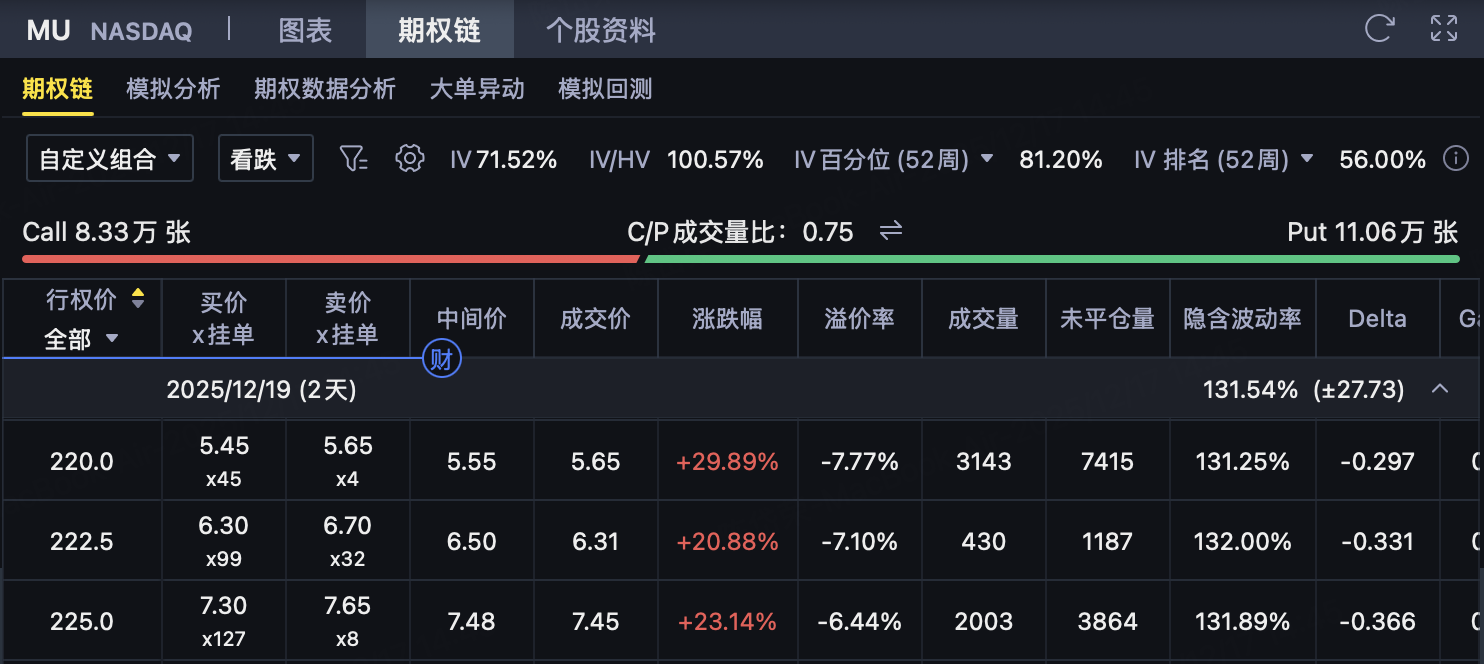
Buy lower strike price Put: K ₁ = 215, premium spend$3.95
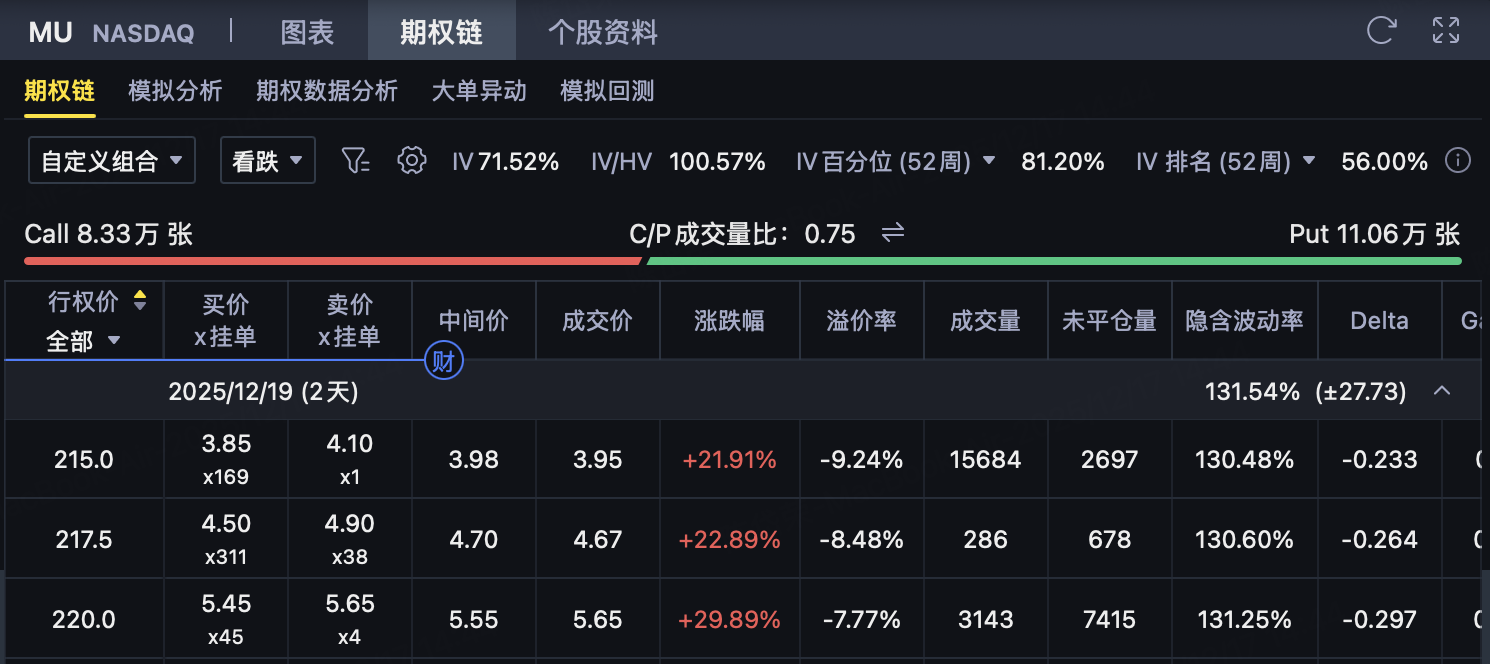
Put-side net income (per share): = 5.65 − 3. 95 =$1.70
This portion is used to collect premium when the stock price does not fall significantly.
(2) Call side (bearish spread, bearish)
Sell lower strike price Call: K ₃ = 255, premium revenue$3.67
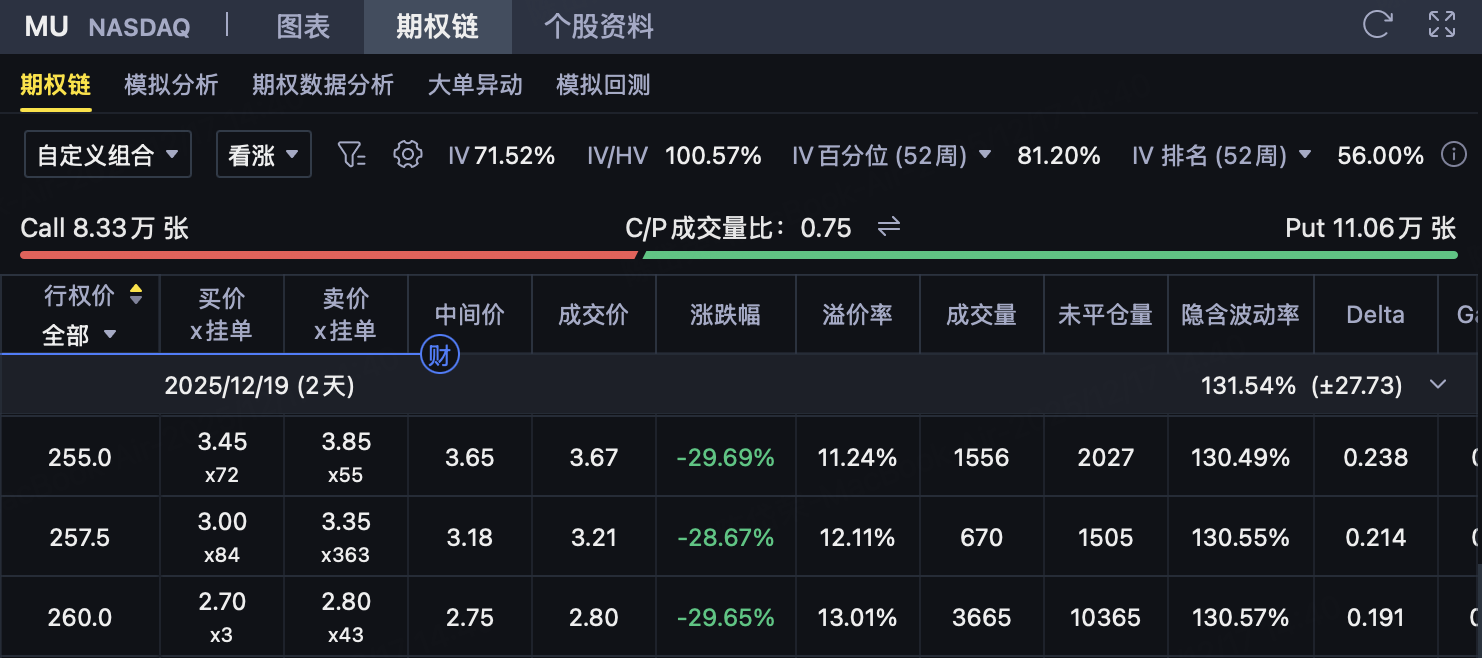
Buy higher strike price Call: K ₄ = 260, premium spend$2.80

Call-side net income (per share): = 3.67 − 2. 80 =$0.87
This portion is used to collect premium when the stock price does not rise significantly.
Initial net income
The total net premium of Iron Eagle Strategy is the sum of the net income of the Put side and the Call side:
Net premium (per share) = 1.70 + 0.87 =$2.57/Share
1 lot = 100 shares, so:
Total net income obtained by investors when opening positions = 2.57 × 100 =$257/contract
ThisIt is also the strategyMaximum potential profit。
3. Maximum profit
When MU Expiration PriceBetween $220 and $255 inclusiveTime:
Two parts of Put and two parts of Call are extra-price
All four options go to zero
Maximum profit (per share) = Net premium received =$2.57
Total maximum profit = 2.57 × 100 =$257/contract
4. Maximum loss
The biggest loss of the Iron Eagle strategy occurred whenOne-sided spread fully triggeredTime (the price drops or rises sharply).
One-sided strike spread
= $5 (220 − 215 or 260 − 255)
Maximum loss (per share) = Strike spread − Net premium = 5 − 2.57 =$2.43/Share
Total maximum loss = 2.43 × 100 =$243/contract
Occurrences include:
MU expiration price ≤ US $215 (full price on the Put end)
Or MU expiration price ≥ US $260 (full price at the Call end)
5. Break-even point
The Iron Eagle strategy has two break-even points:
Below breakeven point = Put sell strike price − Net premium = 220 − 2.57 =$217.43
Above break-even point = Call sell strike price + Net premium = 255 + 2.57 =$257.57
Maturity judgment rules:
Between USD 217.43 ~ USD 257.57→ Earnings for investors
= 217.43 or $257.57→ flat
≤ 217.43 or ≥ 257.57 USD→ Investor losses
6. Risk and return characteristics
Maximum benefit:$257/Contract (Limited)
Maximum loss:$243/contract (limited)
Profit-loss ratio: gain: loss ≈ 257: 243 ≈1: 0.95
Strategy features:
Receiving time value
Limited bilateral risk
The requirements for direction judgment are not high, but forVolatility and range judgment requirements are high
Applicable scenario: investor expectationsMicron holds range-bound ahead of expiration date, neither will fall sharply below 220, nor will it rise sharply to exceed 255. I hope to obtain premium gains by selling options on the premise of controlling risks.
Disclaimer: Investing carries risk. This is not financial advice. The above content should not be regarded as an offer, recommendation, or solicitation on acquiring or disposing of any financial products, any associated discussions, comments, or posts by author or other users should not be considered as such either. It is solely for general information purpose only, which does not consider your own investment objectives, financial situations or needs. TTM assumes no responsibility or warranty for the accuracy and completeness of the information, investors should do their own research and may seek professional advice before investing.
