


Amazon's overbought signal appears, can it still rise?
$Amazon (AMZN) $The stock price has shown an upward trend in recent days. On 2026-01-07, it rose 3.08% intraday, and closed at 246.29 USD on 2026-01-09, up 1.96% from the previous day).
Amazon's strategic actions in the field of AI have become a key driving force. For example, the company plans to invest US $10 billion in OpenAI to strengthen AI technical barriers, which is seen by the market as a signal to improve long-term competitiveness. At the same time, the Bank of America Securities report predicts that 2026 will be the "first year of independent AI", and Amazon is listed as one of the leading stocks due to its layout in cloud services (AWS) and smart commerce.
Amazon is currently facing technical overbought, rising short pressure, uncertainty in AI investment returns and policy risks that may trigger a stock price correction. It is necessary to pay attention to the key support level of $231.43 and changes in short-term capital flows.
As of 2026-01-09, Amazon's stock price was reported at US $246.29, an increase of 1.96% from the previous day. The cumulative increase on the 5th reached US $4.73 (1.96%), close to the 52-week high of US $258.60. The current stock price has broken through the support level of $231.43 (2026-01-08), but it is only 1.2% away from the resistance level of $249.13. Technical indicators show short-term overbought risk.
The trading volume on January 9 was 39.5098 million shares, with a volume ratio of 0.89 (lower than 1), indicating that the upward momentum has weakened. If the subsequent trading volume cannot match the breakthrough of resistance level, profit-taking may be triggered.
On 2026-01-07, the short trading volume was 4.5152 million shares, accounting for 10.69% of the total trading volume of the day, a significant increase from 8.86% on 2025-12-23. Recently, the average short trading volume has remained in the range of 4 million-5.5 million shares, indicating that some funds are betting on a correction.
Although the average target price of 72 institutions is US $291.20 (the highest is US $360), the lowest target price of US $227.10 implies a potential downside of 7.8%, so we need to be wary of the risk of optimistic expectation revision.
AMZN Bear Call Spread Strategy
1. Strategy structure
Investors inAmazon.com (AMZN)Build aBear Call Spread Bear Call SpreadStrategy. The strategy passesSell lower strike price Call + buy higher strike price CallConstitute, belonging toLimited benefits, limited risksThe bearish or shock strategy is suitable for judging the situation that AMZN is difficult to rise sharply in the short term.
(1) Sell Call with lower execution price (main source of income)
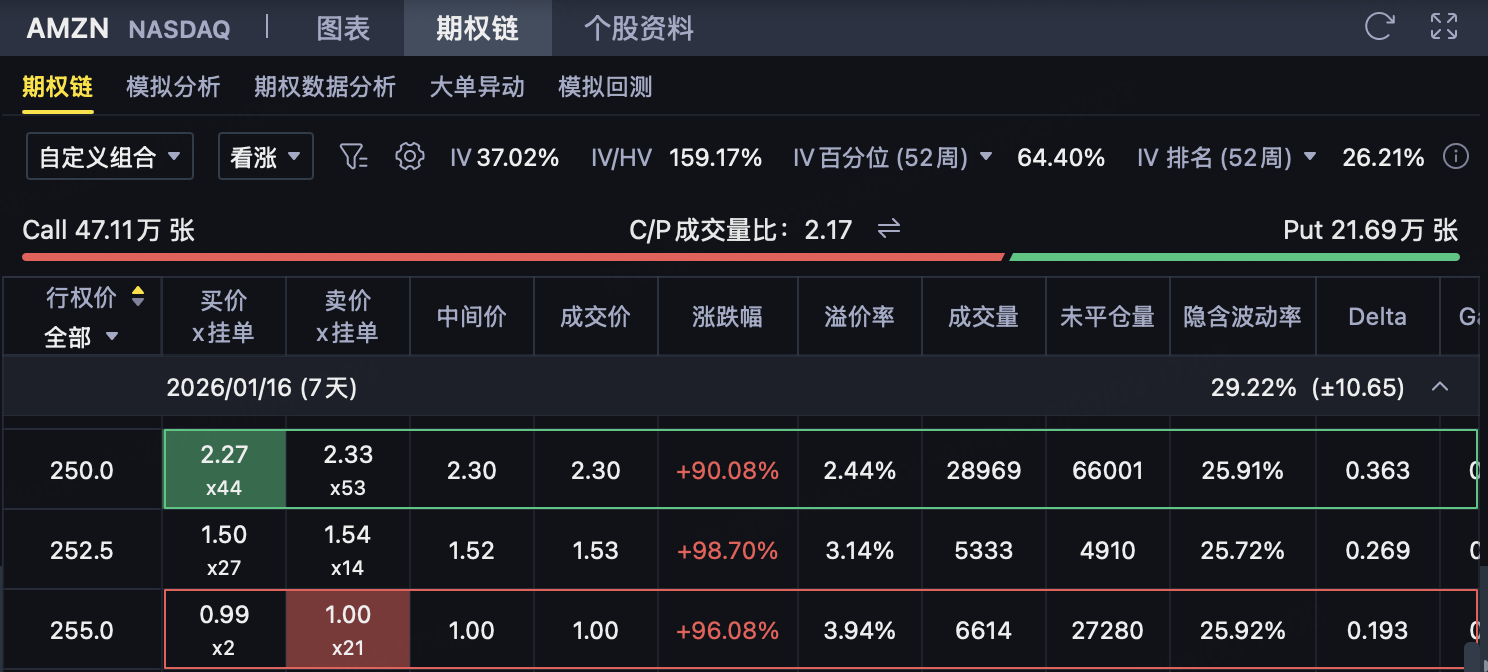
Sell strike priceK ₁ = 250Call
Premium receivedUS $2.3/share
This Call is closer to the current price and is the main source of premium for this strategy. As long as AMZN expiration price≤ US $250, the option will be completely invalid, and investors can retain all premium rights.
(2) Buy a higher execution price Call (risk protection)
Buy Strike PriceK ₂ = 255Call
Payment premiumUS $1/share
The role of this Call is when AMZN sees a big upswingLimit the maximum loss, so that the risk of the overall strategy is strictly capped.

(3) Call-side net income (per share)
Net premium = Sell Call − Buy Call = 2.3 − 1 =US $1.3/share
Initial net income
Since 1 lot of options = 100 shares:
Net premium (per share):$1.3
Initial net income (per contract): = 1.3 × 100 =$130/contract
The initial net income is the bear market call spread strategyMaximum potential profit。
3. Maximum profit
WhenAMZN Expiration Price ≤ $250Time:
250 Call and 255 Call are extra-price
Both options lapse
Investors get maximum profits:
Per share:$1.3
Per contract:$130
4. Maximum loss
The largest loss occurs whenCall spread fully triggeredThe situation, that is, AMZN has risen significantly.
Strike spread width: = 255 − 250 =$5
Maximum loss (per share): = Strike spread − Net premium = 5 − 1.3 =$3.7/share
Maximum loss (per contract): = 3.7 × 100 =$370/contract
Conditions of occurrence:
AMZN Expiration Price≥ $255
5. Break-even point
There is only one break-even point for bear call spreads:
Breakeven Price = Sell Call Strike Price + Net premium = 250 + 1.3 =$251.3
Maturity judgment rules:
AMZN < $251.3 → Earnings for Investors
AMZN = $251.3 → No Profit, No Loss
AMZN > $251.3 → Investor losses
6. Risk and return characteristics
Maximum benefit: $130/contract (limited)
Maximum loss: $370/contract (limited)
Profit-loss ratio: Gain: Loss ≈ 130: 370 ≈1: 2.85
7. Strategic characteristics and applicable situations
Strategy Characteristics
Bearish or oscillating strategy
The core assumption isAMZN won't rise significantly
Receive time value by selling Call
The maximum risk and maximum return can be clarified when opening a position
There is no need for the stock price to fall, as long as it does not break through the key resistance level
Applicable situations
When investors judge:
AMZN in the short termShock or slight decline
Before expirationBreakout of $250-255 range unlikely
Hope inIdentify the maximum riskObtain stable premium income on the premise of
Disclaimer: Investing carries risk. This is not financial advice. The above content should not be regarded as an offer, recommendation, or solicitation on acquiring or disposing of any financial products, any associated discussions, comments, or posts by author or other users should not be considered as such either. It is solely for general information purpose only, which does not consider your own investment objectives, financial situations or needs. TTM assumes no responsibility or warranty for the accuracy and completeness of the information, investors should do their own research and may seek professional advice before investing.
- 闪电侠08·01-09Okkkk1Report