


The Nasdaq continues to fluctuate, how to stabilize returns?
Last Friday, stimulated by positive U.S. non-farm payrolls data,$Nasdaq 100ETF (QQQ) $It rose sharply by about 1%, breaking through the pressure level of the previous convergence triangle, and the short-term bulls were active. However, U.S. stocks fell back in night trading today, led by the Nasdaq index, mainly affected by the news that Federal Reserve Chairman Jerome Powell was criminally investigated by the U.S. Department of Justice. The market is worried that the independence of the Federal Reserve may be damaged, thus affecting the continuity of monetary policy. Coupled with the release of key economic data (CPI, PPI, retail sales) this week and the start of the earnings season, investors generally increase their defensive positions, and risk assets are under pressure, while safe-haven assets such as gold have risen significantly.
The Nasdaq, as a sector dominated by technology stocks, is particularly sensitive to policy uncertainty. The news of Powell's investigation exacerbated the market's uncertainty about interest rate cut expectations, triggering a sell-off in growth stocks, and short-term volatility was significantly amplified. Although from a positive perspective, investigative pressure may prompt the Federal Reserve to accelerate dovish policies, thus supporting the stock market in the short term, the overall sentiment is still cautious, and the market is experiencing liquidity contraction.
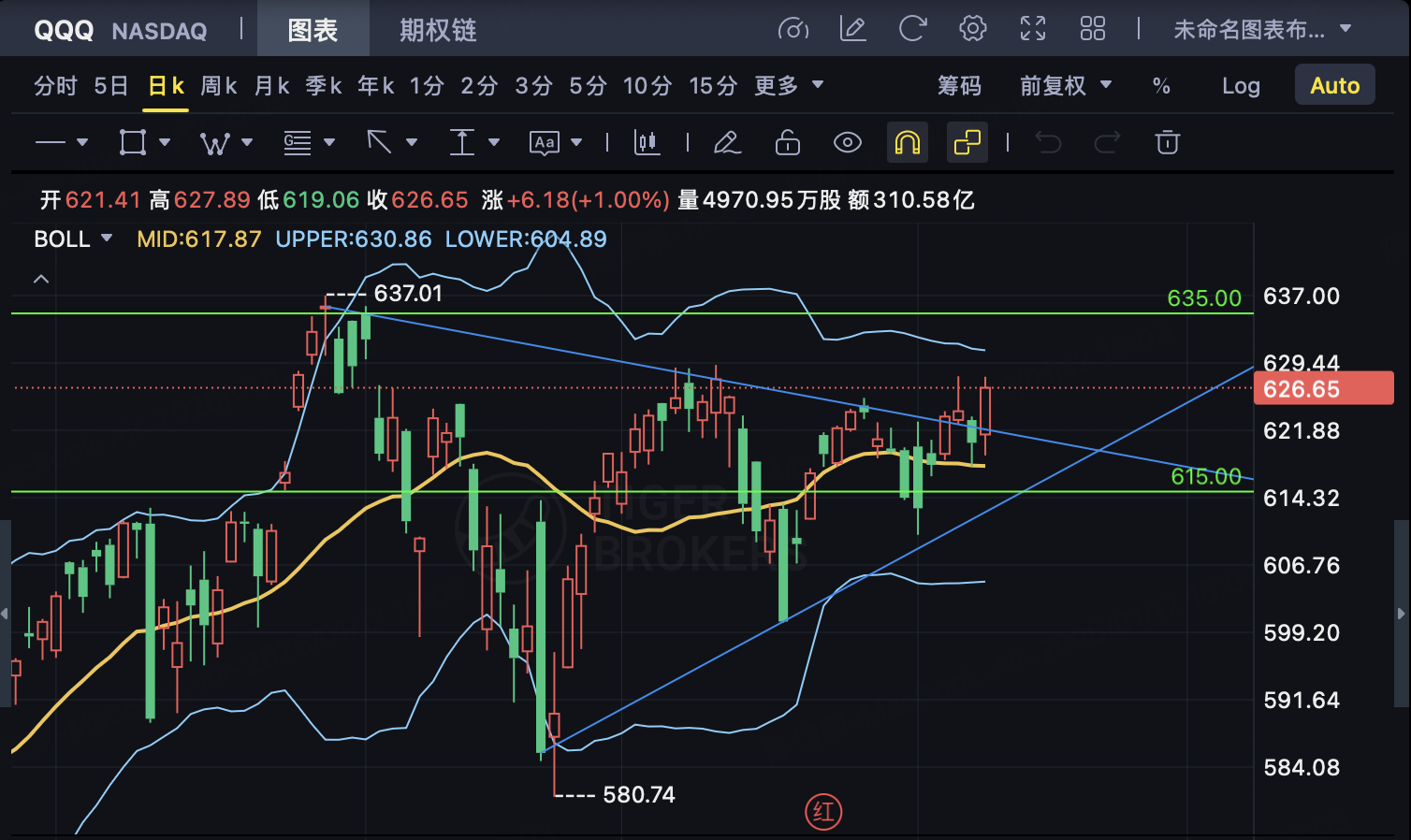
Against this backdrop, investors faceA situation where stock index fluctuates but risk events are uncertain。 For short-term shocks and range-bound markets,QQQ sell iron eagle strategyBecome a viable option. This strategy achieves limited returns but controllable risks by simultaneously selling options close to support and resistance and buying more distant protection options. It is suitable for capturing premium returns under the influence of policies and data events while preventing the risk of large fluctuations.
QQQ Sell Iron Eagle Options Strategy
1. Strategy structure
Investors inQQQBuild aSell Iron Eagle Short Iron CondorStrategy. This strategy is composed of a set of Put Call spreads and a set of Call Put spreads on the same expiration date. The core goal is to collect premium at one time. It is suitable for investors to judge that QQQ has a high probability of maintaining range shocks before the expiration date. There is no obvious unilateral breakthrough.
(1) Put end (bullish spread, bullish)
Sell higher strike pricePut: Investors sell Put with strike price K ₂ = 615 and charge premium $2.75. This option is closer to the current stock price and is the main source of premium on the Put side.
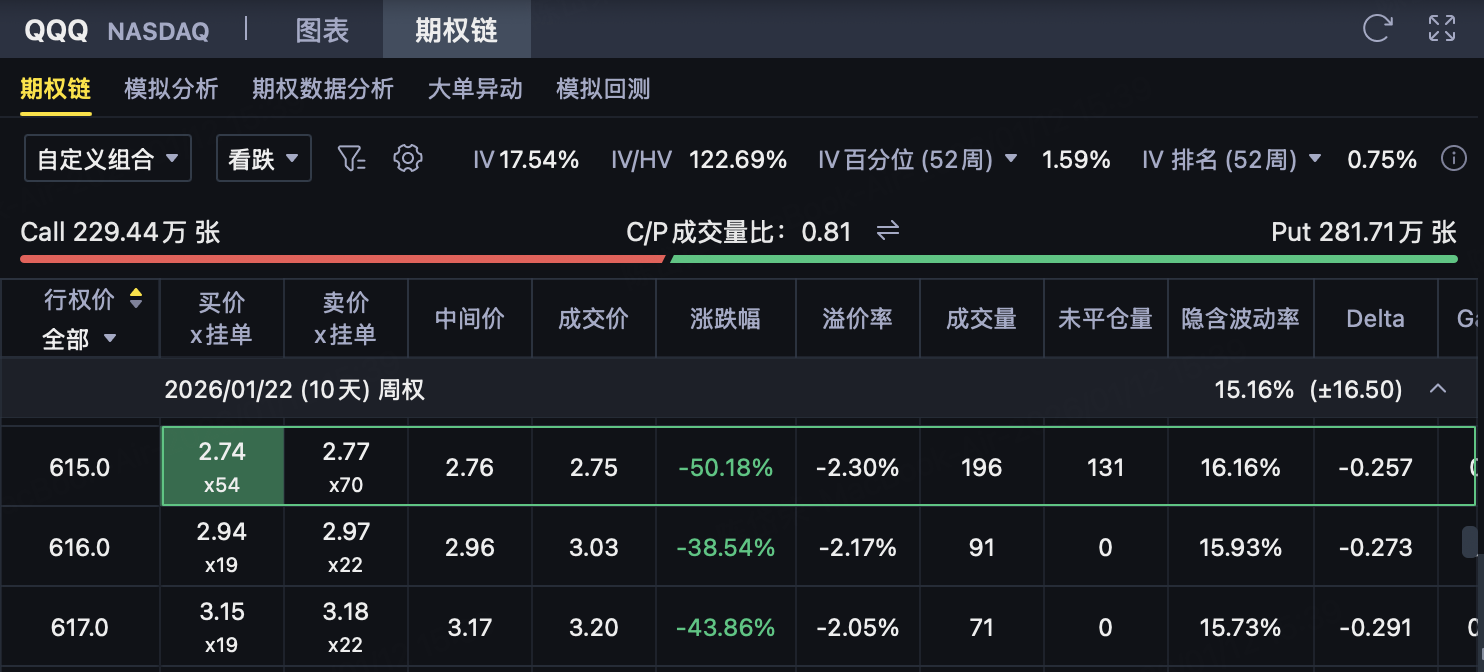
Buy Lower Strike Price Put: Investors buy Put with strike price K ₁ = 610, paying premium $1.94, which is used to limit the maximum loss in the event of a sharp decline in QQQ.
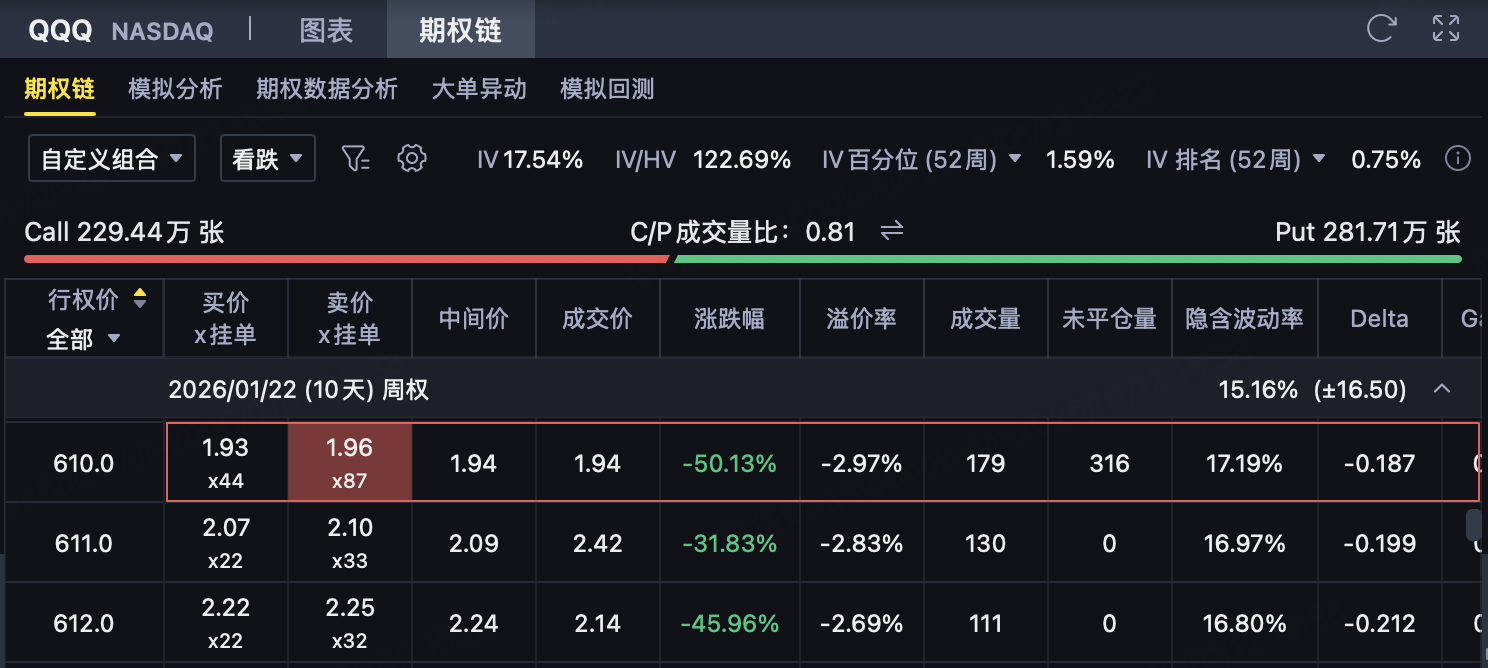
Put-side net income (per share):
= Sell Put − Buy Put
= 2.75 − 1.94
= $0.81
This component provides investors with premium gains when the QQQ expiration price does not significantly fall below $615.
(2) Call side (bearish spread, bearish)
Sell lower strike priceCall: The investor sells the Call with the strike price K ₃ = 635 and charges premium $3.13. This option is the core revenue source of the Call side.
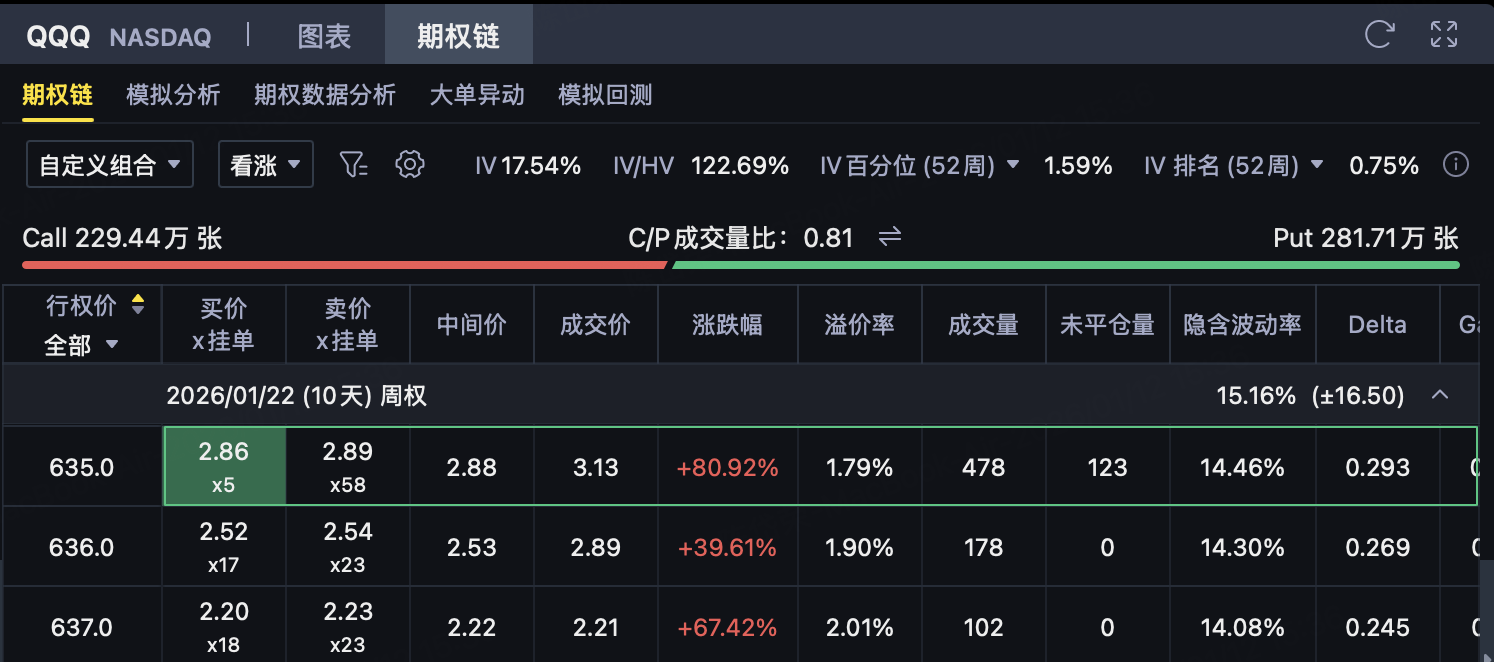
Buy higher strike priceCall: Investors buy a Call with an exercise price of K ₄ = 640 and pay premium $1.55, which is used to hedge risks and cap losses when QQQ rises sharply.
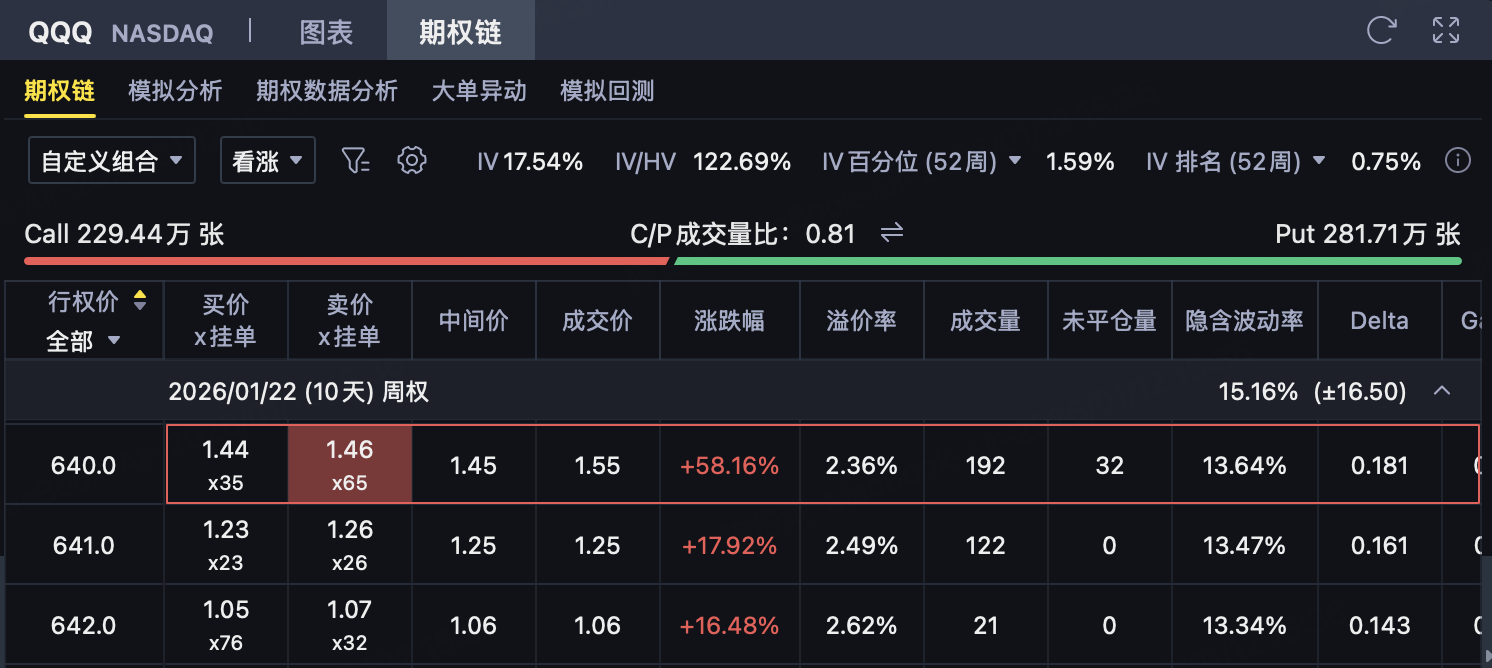
Call-side net income (per share):
= Sell Call − Buy Call
= 3.13 − 1.55
= $1.58
This part contributes returns to investors without the QQQ expiration price significantly exceeding $635.
3. Initial net income
The total net premium of the selling Iron Eagle strategy is the sum of the net income of the Put side and the Call side:
Net premium (per share):
= 0.81 + 1.58
= $2.39/share
Since 1 lot of options = 100 shares:
Total net income earned by investors when opening positions:
= 2.39 × 100
= $239/contract
This is also the maximum potential profit that this strategy can make.
4. Maximum profit
When the QQQ expiration price * * is between US $615 and US $635 (inclusive) * *:
Both options on the Put side and Call side are out of the money
All four options zeroed Maximum profit (per share): = Net premium received = $2.39 Maximum profit (per contract): = 2.39 × 100 = $239/contract
5. Maximum loss
The biggest loss of selling the Iron Eagle strategy occurs when the unilateral spread is completely triggered, that is, QQQ rises or falls sharply.
One-sided strike spread:
= $5 (615 − 610 or 640 − 635)
Maximum loss (per share):
= Strike spread − Net premium
= 5 − 2.39
= $2.61/share
Maximum loss (per contract):
= 2.61 × 100
= $261/contract
Occurrence situations include:
QQQ expiration price ≤ 610 (Put end is in full price)
Or QQQ expiration price ≥ 640 (Call end is fully within the price)
6. Break-even point
There are two break-even points in this selling Iron Eagle strategy:
Break-even point below: = Sell Put strike price − Put side net income = 615 − 2.39 ≈ $612.61
Above break-even point: = Sell Call strike price + Call side net income = 635 + 2.39 ≈ 637.39 USD
Maturity judgment rules:
Between $612.61 ~ $637.39 → Earnings for investors
= 612.61 or $637.39 → flat
≤ 612.61 or ≥ 637.39 USD → Investor loss
VII. Risk and return characteristics
Maximum gain: $2.39/share ($239/contract, limited)
Maximum loss: $2.61/share ($261/contract, limited)
Profit-loss ratio: gain: loss ≈ 239: 261 ≈ 1: 1.09
Strategy features:
Focusing on the collection of time value and the decline of implied volatility
Bilateral risks are limited, and the maximum loss can be clarified when opening a position
The requirements for direction judgment are not high, but the requirements for price range and volatility judgment are higher
Applicable scenario: When investors expect that QQQ's stock price will most likely fluctuate within the range of US $615 ~ US $635 before the expiration date, it is unlikely that there will be a trend breakthrough. At the same time, they hope to obtain premium by selling the option portfolio on the premise of clarifying the maximum risk. When it comes to gains, this selling iron eagle strategy has high practical reference value.
Disclaimer: Investing carries risk. This is not financial advice. The above content should not be regarded as an offer, recommendation, or solicitation on acquiring or disposing of any financial products, any associated discussions, comments, or posts by author or other users should not be considered as such either. It is solely for general information purpose only, which does not consider your own investment objectives, financial situations or needs. TTM assumes no responsibility or warranty for the accuracy and completeness of the information, investors should do their own research and may seek professional advice before investing.
