


Tech Stocks Drop to Support, Spread Layout Rally Opportunity
Recently, the technology sector of U.S. stocks began to show signs of technical stabilization after experiencing a phased correction. Affected by the gradual clarity of the interest rate path in the United States and the return of funds to growth stocks, the overall performance of the semiconductor sector is relatively strong. As one of the core targets of AI computing power,$American Supermicro Corporation (AMD) $After the early callback, it gradually approached the intensive transaction area and technical support range in the early stage, and the market selling pressure weakened. From the perspective of technical structure, the stock price has obviously undertaken in the area of about 185-188 USD. This position is not only the early breakthrough platform, but also near the recent callback low, which has strong supporting significance. If the market sentiment remains stable, AMD has a high probability of fluctuating or technically rebounding near this area. In this case, it is a relatively stable strategy choice to collect premium on the premise of controlling risks by constructing a bull market bearish spread strategy.
Strategic Structure
Investors in$American Supermicro Corporation (AMD) $Build a Bull Put Spread strategy on options.
This policy belongs toBullish/volatile strategy of charging premium, limited income and limited riskIt is suitable to judge that AMD before maturityDo not break below key support levels, maintain volatility, or rebound slightlyOf the situation.
1 ️ ⃣ Sell higher strike price Put (main source of income)
-
Sell 1 strike priceK₁ = $190Put of
-
premium charged =$4.63/Share
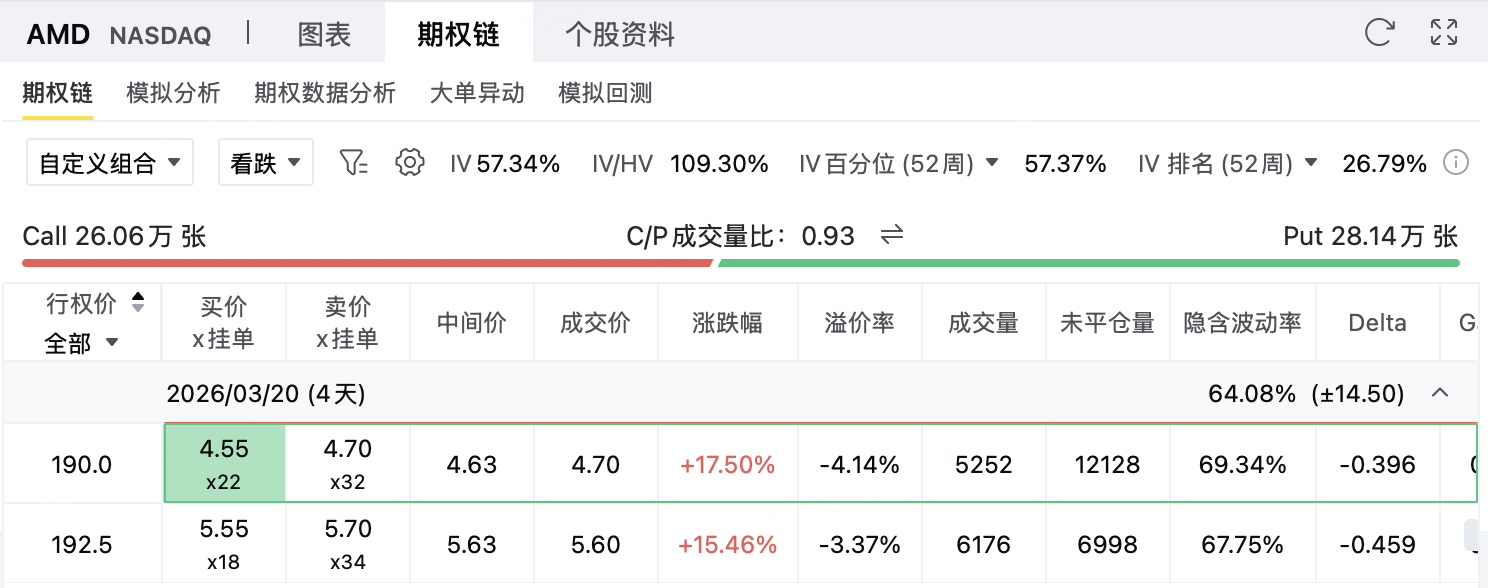
The Put is closer to the current price and is a major source of revenue for Strategy premium.
As long as the expiry price≥ $190, the option will lapse and the investor retains all premium rights.
2 ️ ⃣ Buy lower strike price Put (risk protection)
-
Buy 1 strike priceK₂ = $187.5Put of
-
Paid premium =$3.78/Share

This Put is used to limit the maximum loss in the event of a significant market decline.
3 ️ ⃣ Net premium Income
-
Net income =4.63 − 3.78=$0.85/Share
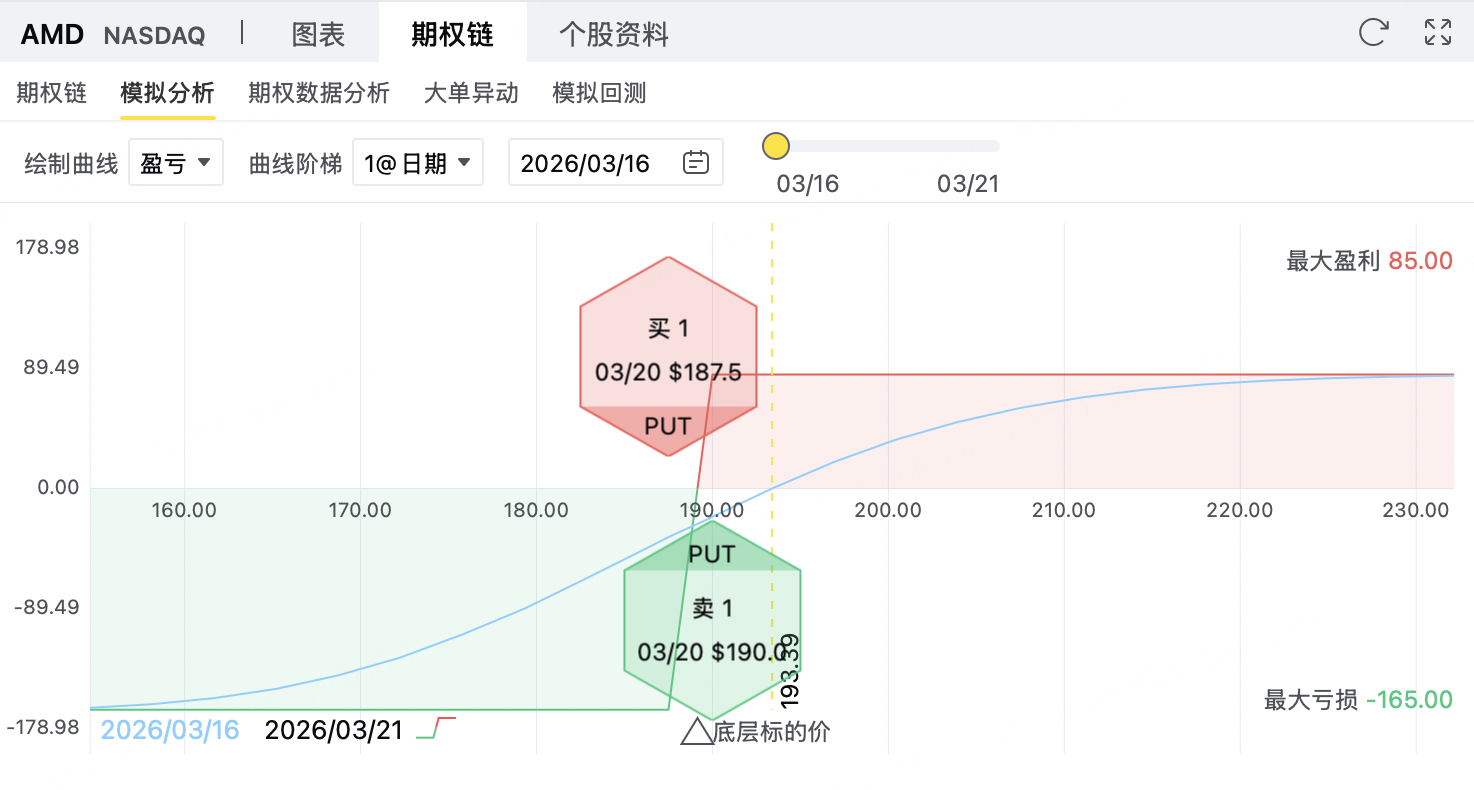
Maximum Profit
Maximum Profit =Net premium Revenue = $0.85/Share
=$85/Spread per Group
Realization Conditions:
Upon maturityAMD ≥ $190
Both PUTs lapse and investors receive full premium.
Maximum loss
Spread width =190 − 187.5=$2.5
Maximum loss =2.5 − 0.85
=$1.65/Share
=$165/Spread per Group
Occurrence conditions:
Upon maturityAMD ≤ $187.5
BREAK-EVEN POINT
Breakeven price =
190 − 0.85
=$189.15
As long as it expiresAMD ≥ $189.15, the strategy overall remains profitable.
V. Strategy characteristics and applicable scenarios
1 ️ ⃣Suitable for support level volatility
AMD recently pulled back to the intensive trading area and technical support area in the early stage, and the market downside is limited, so it is suitable to collect time value by selling the Put spread.
2 ️ ⃣Limited risk
After buying protective Put, the maximum loss is limited to $165, avoiding the downside risk of selling Put alone.
3 ️ ⃣Time Value Decay Favorable
As the expiration date approaches, the option time value gradually decreases, which is beneficial for the strategy to be profitable.
4 ️ ⃣relatively high winning percentage
As long as AMDNot significantly below near $189, strategy can be profitable.
Overall, against the backdrop of AMD's pullback to the support zone and signs of stabilization, through190/187.5 Bull Bearish SpreadCollecting premium is a sound strategy to engage in a potential rebound while controlling risk.
Disclaimer: Investing carries risk. This is not financial advice. The above content should not be regarded as an offer, recommendation, or solicitation on acquiring or disposing of any financial products, any associated discussions, comments, or posts by author or other users should not be considered as such either. It is solely for general information purpose only, which does not consider your own investment objectives, financial situations or needs. TTM assumes no responsibility or warranty for the accuracy and completeness of the information, investors should do their own research and may seek professional advice before investing.
