


Before You Buy the Gold Dip, Revisit the Three Most Important Gold Rallies in History
First, let's take a step back: why did precious metals suddenly plunge?
most people in the market see three main explanations for the sharp drop in gold and silver:
Logic 1: Global central banks have turned more hawkish, and higher interest rates effectively raise the cost of holding precious metals.
Logic 2: The Middle East conflict has created an oil shortage, and energy has replaced precious metals as the “hard currency” of choice.
Logic 3: Gold and silver were heavily crowded trades, and profit taking on stretched long positions has triggered a selling spiral.
But I’m not really convinced by any of the three explanations above
I broke these three arguments down in detail and leaned more toward a different interpretation: gold and silver are being sold as assets to raise cash, which means the market is facing a liquidity crisis.
The most recent case that looks like this was in March 2020. The pandemic triggered repeated limit-down moves in U.S. equities, and gold and silver also went into a nosedive. Here is a screenshot to illustrate that move.
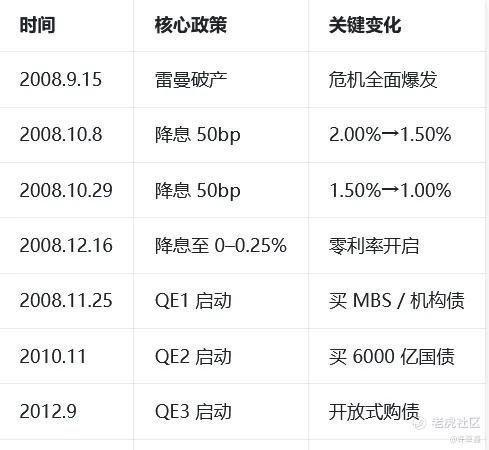
To counter the negative shock from the pandemic, the Fed delivered two emergency rate cuts within half a month, taking rates straight down to 0–0.25% (hikes did not begin until after the Russia-Ukraine conflict in 2022). At the same time, it launched a 700 billion dollar QE program and complementary tools, making it the most aggressive round of monetary easing since the financial crisis.
You can see this clearly on the daily gold chart: gold dropped nearly 15% in less than ten trading days, but once the Fed easing kicked in, gold not only retraced the decline in a more sustained move, it eventually went on to make new highs.
If March 2020 was a textbook liquidity crisis episode, the previous case that really left an impression on me was 2007–08.
Gold first began rising from around 254 in 2001 and climbed to 1,032 by March 2008. After the subprime crisis broke and Lehman collapsed, gold fell back to 680. As the chart shows, that was a 34% drawdown in just over six months.
The pattern was similar: the Fed cut rates first, then rolled out QE. From 680, gold started a new leg higher, not only breaking the 1,032 high, but ultimately rallying all the way to 1,920.50 dollars per ounce in September 2011.
I lived through both of those cycles, which is why they left such a deep impression.
However, the cycle we are going through now may not look exactly like 2020 or 2008. It actually looks more like another historical episode that I never personally experienced: the 1970s to 1980s.
Because my software only lets me pull data back to 1992, this period can only be described in words.
On August 15, 1971, U.S. President Richard Nixon announced the closing of the gold window, ending the official commitment to convert 35 dollars into 1 ounce of gold. That meant the dollar was formally decoupled from gold and the core pillar of the Bretton Woods system collapsed.
In March 1973, the major Western currencies shifted to floating exchange rates against the dollar, and the fixed rate system fully broke down.
As the dollar was repriced, gold began a spectacular ten year bull market. In rough outline: 1971–1974: Decoupling from gold, dollar depreciation, and the first oil shock pushed gold from 35 to 180 dollars, a cumulative gain of 414%.
At the same time, the world faced an economic crisis, a financial crisis, an oil crisis, and an inflation crisis – the “big crisis” of 1973–75. Oil prices quadrupled, and major stock indices around the world fell 30%–60%.
Against that backdrop, gold surged, but when the crisis hit full force, gold was again sold as an asset to raise liquidity.
From 1975 to 1976, gold dropped from 180 dollars back to 100, a cumulative decline of 44.4%.
From 1977 to 1980, during the second oil shock, U.S. inflation above 14%, and the Iranian Revolution, gold soared from 100 to a peak of 850 dollars per ounce.
After that came Paul Volcker’s aggressive rate hikes to 20%, which crushed inflation and strengthened the dollar. Gold then entered a 20 year bear market. From 1980 to 2000, the price fell from 850 dollars to around 250.
Now, if your thinking is clear, you can link this back to what we said earlier about gold rising from around 254 in 2001 to 1,032 in 2008.
History often rhymes, but it does not simply repeat.
That is why I always stress the importance of seriously studying fundamentals. Even if, like me, you never personally experienced the 1970s–80s gold market, you can still pick up some interesting details from it.
Detail 1: From 2016 to 2026, gold has risen from 1,062 to 5,600, a maximum cumulative gain of 427%. Does that look a lot like the 1971–74 move?
Detail 2: From 5,600 down to 4,098, the maximum cumulative drawdown so far is 26.82%. Does that look like we have not yet finished the 1975–76 leg?
Detail 3: The parallels go further: a repricing of dollar credibility, an oil shock, and the risk of the global economy slipping into a stagflation like environment.
So, unless something very unexpected happens, as the global crisis unfolds and central banks step in to stabilize markets, we are likely to experience something similar to the 1977–80 phase.
For that reason, I do not believe 5,600 dollars per ounce is the ultimate peak of this gold bull market.
$Gold - main 2606(GCmain)$ $E-Micro Gold - main 2606(MGCmain)$ $1-Ounce Gold - main 2606(1OZmain)$ $Silver - main 2605(SImain)$ $E-mini Silver - main 2605(QImain)$ $Silver - Mar 2026(SI2603)$ $iShares Silver Trust(SLV)$ $SPDR Gold ETF(GLD)$
$Invesco DB US Dollar Index Bullish Fund(UUP)$ $10-YR T-NOTE - main 2606(ZNmain)$ $Euro FX - main 2606(EURmain)$ $Japanese Yen - main 2606(JPYmain)$
Disclaimer: Investing carries risk. This is not financial advice. The above content should not be regarded as an offer, recommendation, or solicitation on acquiring or disposing of any financial products, any associated discussions, comments, or posts by author or other users should not be considered as such either. It is solely for general information purpose only, which does not consider your own investment objectives, financial situations or needs. TTM assumes no responsibility or warranty for the accuracy and completeness of the information, investors should do their own research and may seek professional advice before investing.
- MarsBloom·03-31TOPSpot on! Historical parallels suggest gold's rally isn't over yet. [强]2Report
- quiettt·03-31TOPSpot on! Gold's dip is a prime chance to load up, history echoes. [看涨]2Report
- Ah_Meng·04-03The timeline is the only thing that differs and must be managed carefully if you have inferred here is correct. Especially what comes after that gold rally is a long term bear… but I do agree that a new gold peak might be on the way…1Report
- Kerry2·04-01That’s a really good point1Report
- decors imago·04-01Great article, would you like to share it?1Report